
A few years ago I contacted New York City’s Metropolitan Transit Authority to inquire about a curious piece of signage near the midpoint of the Bronx-bound RFK/Triborough Bridge. Motorists and pedestrians entering the Bronx from Queens are greeted with a highly-placed (but not highly inspirational) message: “LIFE IS WORTH LIVING”. The sign, directed at emotionally distressed individuals intending to take their lives by jumping from the bridge, claims that a public telephone “AHEAD 150 FEET” will connect to a suicide counseling hotline. Those 4 words “PHONE AHEAD 150 FEET” rank among the shortest works of fiction ever written. This sign is a lie. My 2 eyes have not located a phone of any kind on that bridge since signage the MTA announced its existence appeared years ago. The fiction is not that “LIFE IS WORTH LIVING” but that there is a “PHONE AHEAD 150 FEET”.
The RFK/Triborough’s “LIFE IS WORTH LIVING” sign first caught my attention after returning to New York from a trip to San Francisco. A walk over the fabled Golden Gate Bridge revealed numerous suicide counseling phone boxes placed at regular intervals across the span. As I later learned from the documentary film “The Bridge” the number of suicides that take place from the Golden Gate span are epidemic, but the city wisely chooses not to publicize statistics about the numerous incidents that occur there each month. (Is this to attract suicidal purists, or to avoid uninspired copycats?) Similarly in New York neither the Port Authority nor the MTA publicize the number of suicides committed or attempted from our bridges. These incidents are more frequent than most New Yorkers might think.
The hotline phone on the RFK/Triborough (if it existed) would be a product of LifeNet, a suicide-prevention organization in New York. LifeNet fields thousands of calls a month, though the number of calls made from bridges or other precarious places is not specified. According to NYC’s OpenData web site LifeNet handled 85,800 calls in 2012; 82,900 in 2011; and 97,200 calls in 2010. Perhaps it would behoove The Payphone Project’s interest in this matter to request that the city publish a subset of this data detailing how many of those calls came from LifeNet phones on bridges.
Unable to locate a LifeNet phone on the RFK/Triborough I was strangely relieved but nonetheless irked to find that my peers also took a passing interest in the matter. Others had noticed a sign on the RFK/Triborough announcing the presence of a LifeNet telephone. Those same others had further noticed that no such phone exists. Most people I know chuckled at the gallows humor (I did as well) but to me the non-existent RFK/Triborough LifeNet suicide hotline phone seemed like a needless and unnervingly cruel municipal hoax.
Several emergency call boxes dot the pedestrian walkway on the Ed Koch/Queensboro Bridge, though those phones appear to connect straight to 911, not a suicide crisis hotline. I am as yet unable to verify if the Verrazano-Narrows or other bridges in New York actually have LifeNet phones or if the MTA and/or Port Authority merely posted signs claiming such phones are “AHEAD 150 FEET”.
Phones placed in interest of suicide prevention are the kind of public telephone that will never enter most of our lives. One could argue that their value is symbolic: An individual determined to end their life would have, at best, a cynically dismissive regard for such an outlet.
Still, signs are signs, and tax-paying citizens have a right to expect accuracy. If the MTA’s “24 HOUR HOTLINE PHONE AHEAD 150 FEET” is false then why should we believe the agency’s accompanying “USE OF CAMERAS PROHIBITED” sign?
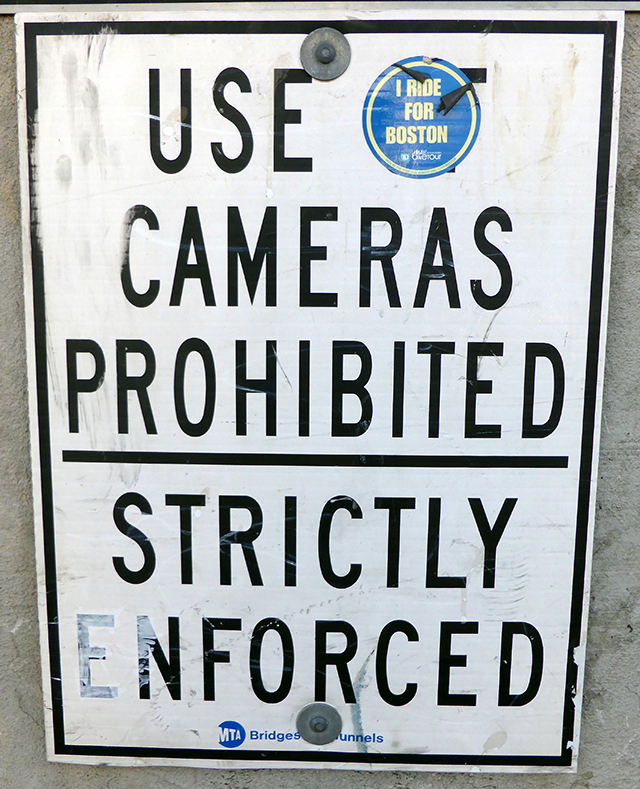
I wrote to the MTA in 2011. I have no intention of re-submitting the inquiry. I have no patience for impenetrable bureaucracies. My inquiry drew this response:
07/05/2011 04:18 PM
Dear Mr. Thomas:
There are LifeNet automated phones located on all three roadway spans of the RFK/Triborough Bridge, but I encourage you to contact LifeNet’s 24/7 hotline immediately if you are in need of counseling. The number is: 212-254-5219.
MTA B&T
Notwithstanding the stated (but needless) concern for my well-being the response was dismaying. Dismaying not only for its conspicuous lack of accuracy but for its wave-of-the-hand dismissal of the possibility that there might be some substance to this relatively obscure issue since someone took precious time out of their day to report it. I do not assume insidious intent but the MTA seemed as willfully oblivious to this as they are to the plague of bicycles that illegally (even suicidally) race along the narrower portions of the RFK/Triborough walkway.
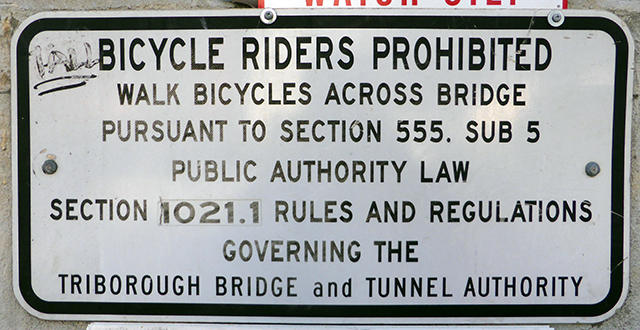
This weekend, before writing this story, I re-visited the site of the alleged LifeNet telephone. I wanted to verify that the fictional claims seen on the “LIFE IS WORTH LIVING” sign remain intact, and that no such phone exists. I honestly hoped a phone would be there, but I did not expect one. My expectation was met.
High above the Hell Gate, from the spot where the “LIFE IS WORTH LIVING” sign stands, I walked 432 steps, stopping at what some would call the RFK/Triborough’s most “attractive” spot for a suicidalist — that spot where the high fence ends and you can look straight down the numbing chasm which separates yourself from the Hell Gate’s ruggedly churning waters. Averaging 2 or 3 feet per pace I had easily passed the 150 point where the MTA claims I should have found that elusive LifeNet phone. No LifeNet telephone was present on the pedestrian walkway of that bridge. Photography on the bridge is forbidden (or so a sign claims) so I offer no photographic evidence. You can trust me on this: the sign is a lie.
Heading back to Queens I spotted something ironically morbid considering the subject matter on my mind. A billboard with the question “DID I REALLY DIE?” drew from me a nervous, forehead-slapping chuckle. I vertically shook my head with dismal respect for the unpublicized, uncopycatted, unknowable individuals who waltzed their last warped solo dance off the RFK/Triborough, off the Verrazano-Narrows, the Ed Koch Queensboro, the Brooklyn Bridge.
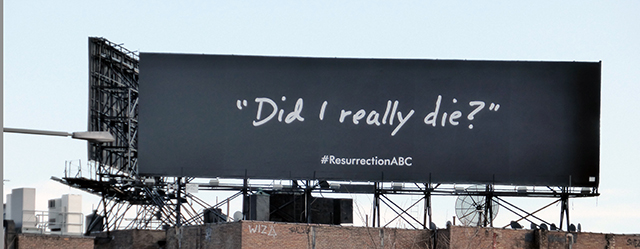
The “DID I REALLY DIE?” billboard refers to ABC’s new TV series “Resurrection” but with the subject matter of bridge-jumpers on my mind I imagined that that question might be among the last to pass through someone’s drowning, spine-snapped, shattered mind after striking the waters of the Hell Gate.
The passage of time plays no part in my dismay about this. I submitted my inquiry to the MTA 3 years ago. In that time I did not expect that anyone would investigate this matter. I am neither a television network nor a particularly influential Tweeter. I am but a common citizen whose inquiries carry no urgency. Nevertheless I continue to half-heartedly imagine that the MTA will do something to debunk the RFK/Triborough’s “LIFE IS WORTH LIVING” fiction by either removing the sign altogether or by installing a working LifeNet telephone.