
UPDATE, OCTOBER, 2014: The trailer for “Hang Up” has been released. Click here to watch.
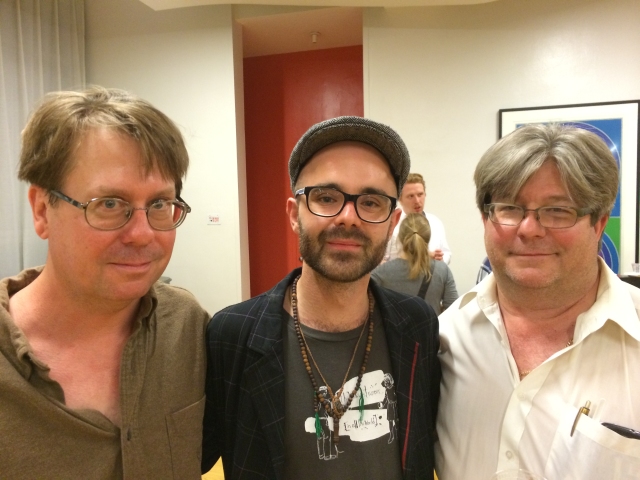
The photo below was taken following the premiere of “Hang Up,” a documentary about New York City payphones by French film maker Ugo Massa. Seen in this photo are myself, Mr. Massa, and John Porter. Mr. Porter owns East Harlem Payphones. John Porter is one of the few people from the real world of public telephones who does not hate The Payphone Project web site. “Hang Up”, produced in association with The New School, was the opening film at the “Truth Be Told Documentary Film Festival“, which played for three nights at The New School’s hipsterly named “The Auditorium” at 66 West 12th Street.
“Hang Up” taps into the fading world of New York City’s public telephones, with an almost rhapsodically elegiac salute to the land line and its aural vagaries.
Heard throughout the film are payphone and land line sounds (expertly recorded and edited by Mr. Massa) that most younger people will probably never hear: dial tones; automated voices demanding “Please deposit 25¢”; coins dropping into coin slots; even the Kafkaesque sound of a nearly-dead payphone droning its humming noise makes a strange, possibly first-of-its-kind appearance in this unusual film.
Filming for my part of the documentary occurred during December, 2013, and February of this year.
In the interest of capturing the grey, raspy, monochrome sound of the land line Ugo Massa and I conducted some of our interviews over John Porter’s East Harlem Payphones.
One call lasted about an hour, during which I shoveled quarter after quarter into a rogue payphone outside a tattoo shop on Steinway Street in Astoria.
Coins deposited into a payphone do not immediately go into the collection chamber. The coin(s) drop in when the caller hangs up. Thus when I finally hung up that payphone the mass of quarters that had piled up dropped down very loudly, an avalanche of coins crashing into the collection box. Such a terrific sound.
Mr. Porter was seen in the film going about his daily routine: maintaining and repairing payphones throughout the city, with his work on a Coney Island payphone seen at the opening of the film.
In addition to hearing his musings and reflections on the state of payphones today we also visit him in his payphone bunker, an apartment stacked to the ceiling with payphones and their infinitely intricate mechanical parts.
Mr. Porter’s appearance was something of a revelation to audience members who assumed that larger telecom monopolies managed outdoor public telephones. In fact most payphones today are operated by small businesses such as John Porter’s East Harlem Payphones (one employee) and somewhat larger advertising concerns. The likes of Verizon and AT&T exited the business completely, although Verizon is still responsible for providing a working dial tone to New York’s payphones.
Verizon frequently and vigorously refuses to provide that dial tone.
The future of the payphone business in New York favors the revenue-ready media companies whose inheritance of the telephones inside their advertising-cloaked enclosures is something of an accident.
An impartial review of “Hang Up” would be impossible from someone as involved with the film as I.
“Hang Up” might not be perfect but I have trouble finding its faults for what it set out to document. A few inaccuracies that only payphonistas such as John Porter and myself would notice slipped through (much to the director’s chagrin when I pointed them out) but the overall attention to detail and respect for the subject matter shown by Mr. Massa is unassailable.
I was gratified that one of my subway payphone sounds made an appearance: the sound of a subway saxophonist playing “Heart And Soul” as heard through a payphone is heard near the film’s end:
Lasting only about 15 minutes I could easily have enjoyed another 15 minutes to a half hour given to other individuals still hanging on to what is left of New York’s independent payphone service providers.
The future of public telephones in NYC favors the deeper pockets of moneyed media entities. The recently announced plan to convert the city’s payphones into WiFi hotspots and multimedia kiosks has attracted interest from some of the biggest media and communications companies in the world. “Hang Up” captured a piece of history by documenting the independent payphone service provider before being once and for all shuffled off the stage by these larger conglomerates.
Having never seen myself on a huge movie screen I was at first unnerved by the experience of attending this film. I have years of experience as a concert classical pianist, so being on a stage or under a spotlight is nothing new to me. This was different in that I was on stage, in front of about 150 people, but I had no control over the situation. I also was unaware I would be asked to sit on stage afterward to field questions from the audience.
I don’t know when or where or even if the film will play again. According to the director it will be shopped around to film festivals, or even reëdited and potentially expanded, though I suspect that’s unlikely.
I am proud of my involvement in the film, proud of my girlfriend for standing by me throughout this experience, and proud of Ugo Massa for delivering such quality work.
As soon as Ugo and I began corresponding I knew that his approach to this subject would not come from the ironic/sardonic angle typical of today’s hyperventilated social media outlets, where some folks have their heads stuck so far up the Internet that they forgot or simply dismissed the analogue world still humming around them.
“Hang Up” reminds us that the non-digital world of communication stubbornly endures. This film poignantly captures its roughly nuanced soundscape.