
The Picturephone scene from 2001 A Space Odyssey, released in 1968, shows what Stanley Kubrick thought payphones would look like a mere 33 years into the future. Kubrick’s payphone of the future not only made phone calls but showed full video of both parties:
Video telephony, a concept almost as old as the telephone itself, had become a viable reality a few years before 2001 was released after Bell Telephone introduced a videophone at the 1964 World’s Fair in Queens, New York.
Making every effort to be as technically cognizant as possible members of Kubrick’s production team had discussions with Bell Labs about how Bell expected the videophone to develop in future decades. Those discussions informed the appearance of the Picturephone in 2001.
I think the number dialed is either 1-434-581-5445 or 1-434-591-5445, but others might see it differently. I am reasonably certain of the first 1+area code part. The 434 area code did not exist in 1968 but strangely enough it came into existence in the year 2001, when 434 was assigned to the area around Lynchburg, Virginia.
If the set from the Picturephone scene in 2001 still exists it would be interesting to see if anything clever is hidden in the text matter, which is unreadable and perhaps consists of nothing but gooey gibberish:
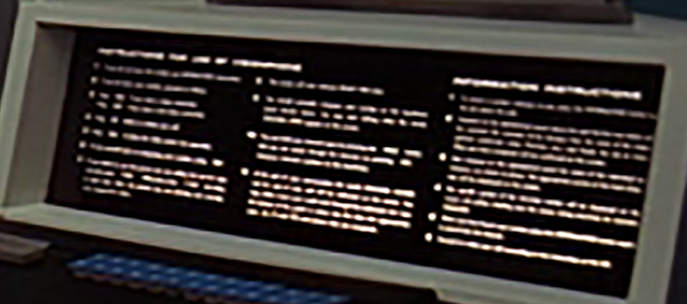
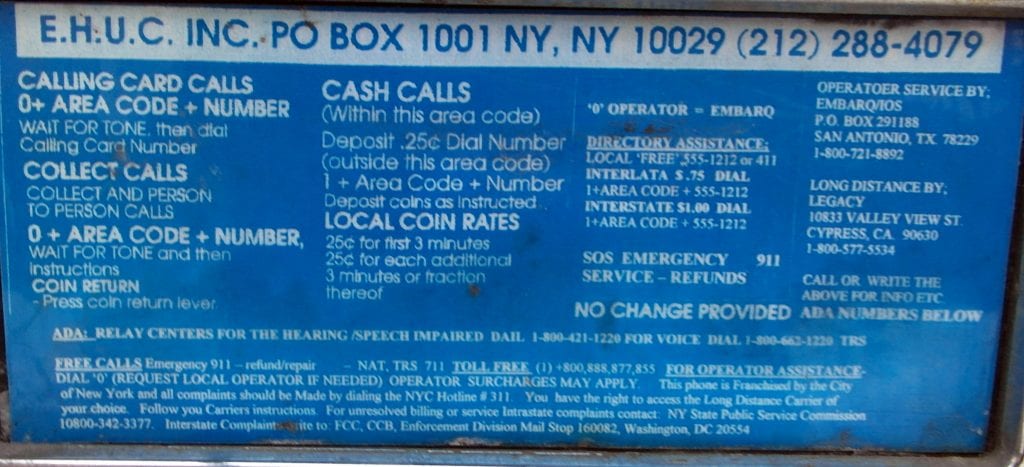
Presumably that text is meant to contain rate information and instructions on how to use the Picturephone, similar in spirit to the informational placards found on payphones of today:
If one adjusts the $1.70 rate in the dollars of 1968, when the film was made, then the cost of the call would have been $8.73 in 2001, or $12.11 in today’s dollars. This is according to the Inflation Calculator. Those rates seem cheap. By comparison I once made a call from an Airfone, the pay-as-you-go phones that used to be found on commercial jets. That was in the mid-1990s. I do not recall exactly how much I was billed but the charge was extortionally higher than the inflation-adjusted rate of $8.73 seen in 2001.
Needless to say I was not calling someone on another planet.
The Picturephone in 2001 is not the first such device to appear in movies. That distinction probably goes to Fritz Lang’s Metropolis, from 1927:
But that videophone is not a payphone device like the one in 2001. Kubrick’s Picturephone is probably the first video payphone to appear on film.
An interesting survey of videophones in movies, from Metropolis in 1927 to Moon in 2009, was compiled by Vimeo user Joe Malia. This survey reveals another appearance of a video payphone device in film, this one from Blade Runner. Set in the year 2019 a local call lasting less than a minute cost Harrison Ford $1.50, which is in the same ballpark but not as good a value as the interplanetary call made in 2001.
Kubrick unintentionally predicted the 434 area code’s creation in 2001, and he also predicted that calls from payphones could one day be paid for with a credit card. But what about the very idea of a video payphone? I was surprised to find that Kubrick called it better than most people probably think.
The video payphone was indeed a reality, and quite a bit earlier than 2001. In 1989 a product called Phonavision was introduced at the University of California’s Berkeley campus, allowing three-minute video calls for a cost of $10 ($20.04 in 2017 dollars). Developed by a company called Communications Technologies the Phonavision was described by its creators as the first-ever videophone meant for public use. I cannot find anything to dispute that claim.
A spokesperson for the company predicted that video payphones would become as common as ATMs. He was wrong. The Phonavision was a well received consummate failure. Here is a grainy newspaper photo of the Phonavision in use, from page 50 of the Arizona Republic, November 1, 1989:

Video calls on Phonavision were paid for with either cash or credit card (no coins). Video quality was said to be poor, with the image of the person you were talking to breaking up if they moved their head just a little bit. The product was in development for three years before being put out for public use but it is not clear to me yet just how long Phonevision lasted or if it was ever profitable (almost certainly it was not).
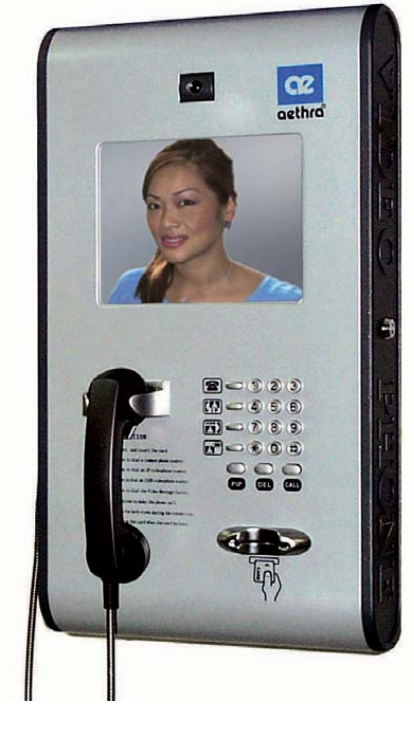
A more focused and sophisticated attempt at the video payphone came in 2003, when the Aethra company introduced what it claimed (falsely, it would seem) was the “first publicly accessible videophone”.
Initially conceived as a device to be placed in hotel lobbies and Internet cafés the target audience for the Aethra video payphone evolved toward prisoners and prison owners. Since the 1990s prisons have been a lucrative (and controversial) market for both payphone service providers and prisons themselves. That market evolved beyond common payphones and has become something of a breeding ground for video payphones and the software that runs them. Renovo Software is a leading purveyor of inmate video visitation products, unabashedly promoting their products’ revenue generation potential.
Prisons are not what Kubrick had in mind for his video payphone. The closest thing we have today to publicly accessible videophones such as those seen in 2001 and Blade Runner are in the form of Internet cafés and pay-per-hour Internet-connected computers with webcams and video conferencing software.
We might be closer to ubiquitous videophone-capable public communication devices than most people think. Citybridge, a consortium of advertising and tech companies, is replacing New York City’s traditional payphones with LinkNYC devices. LinkNYC is first and foremost an advertising platform but as a public relations gambit it also offers free phone calls, access to unreadable social services, transit updates, and other apps.
Among the many promises made about LinkNYC is that it will be possible to make video calls using one of the device’s three creepy cameras. That appears to be what this eyeball icon on the tablet screen is reserved for:

Like other promises from Citybridge with regard to LinkNYC the dream of videophone calls from every street corner will probably not come to pass. It is just too ambitious, and the path toward making video calls to access pornography seems automatic. Even for legitimate usage a videophone on every corner is a poor concept. The phone calling experience is bad enough on LinkNYC as it is now, with the sound of the callee’s voice heard loud and clear by passers by. Add to that the possibility that all those people passing by could see your face and it would seem that only true exhibitionists would answer calls made from LinkNYC’s videophone.