
UPDATE, April 2 2018: Either there was a glitch with this phone or, more likely, I just dialed the wrong number. Read my clarification here. This phone now requires a 50¢ deposit for a 15-minute phone call. I’ll leave this story intact anyway.
=====
It looks like I might have made my last phone call from the last payphone at Rockefeller Center. It must have happened within the last couple of months that the cost of a local call from this phone increased from 50¢ for 15 minutes to $1 for 2 minutes. The old cost was about 3.3¢ per minute. The new rate is 50¢ per minute, a percentage increase of 1415%! Highway robbery, you might say, but it just goes to show how firmly entrenched the payphone business (what’s left of it, that is) is in survival mode.

This might actually be illegal according to rules of the city, since the phone itself clearly states that local calls are 50¢ for 15 minutes. Legal or not it is certainly bad manners, and I have to wonder if there has been any payoff. The number for this phone is (212) 246-8729. If that number shows up on your CallerID just know that whoever called you spent a lot of money trying to reach you.
This phone is owned by Pacific Telemanagement Services (PTS), the largest payphone service provider in the U.S. PTS acquired a portion of Verizon’s payphones back in 2011, after the tech giant announced its exit from the business of payphones and calling cards. Most of the phones PTS picked up were indoors, like this one, and included a quantity of subway phones which at the time must have numbered in the hundreds. Today you can still find PTS payphones at a number of Broadway theaters but the largest quantity of PTS payphones under one roof is probably either at Grand Central Terminal or Penn Station, though many of the phones at the latter have not worked for a long time. The payphones at Grand Central’s upstairs main space are pretty reliable, while only a couple of non-working abandoned phones lurk in the subway station underground.
Discovering that PTS jacked up the rate for this one phone by over 1400% made me curious to see if they did the same at Grand Central or Penn Station. So far, at least, they have not changed anything at Grand Central, where a 15-minute call will still cost you 50¢. I did not make it to Penn Station today but expect no changes have been made there, either.
I heard last year that some payphones on Long Island had been programmed to require a coin deposit of 50¢ to connect a call to a toll-free number, rendering “toll-free” a bit of a misnomer. Of course “toll-free” always was a misleading term. You might not pay for the call but whoever owns it does. But that kind of maneuver, charging money for calls that have historically been free for payphone users, is more evidence that what’s left of the payphone business is in full bore survival mode, charging whatever they can get away with just to keep the phones available.
Charging callers for connecting to toll-free numbers might also have been implemented in anticipation of the impending cessation of what are known as “Dial Around Compensation” (DAC) payments. Under the DAC rules mandated by the FCC a payphone owner is due about 50¢ for every toll-free call made from their payphones, the fee to be paid by the owner of the toll-free number. Collecting those payments has not always been as easy, but entities charged with processing those payments have included (among others) the National Payphone Clearinghouse and the American Public Communications Council. Rumors have circled for a few years now that these entities will stop processing DAC payments and that nobody will take up the task in their wake. This has led some payphone owners to charge callers 50¢ for toll-free calls as a way to recoup their losses.
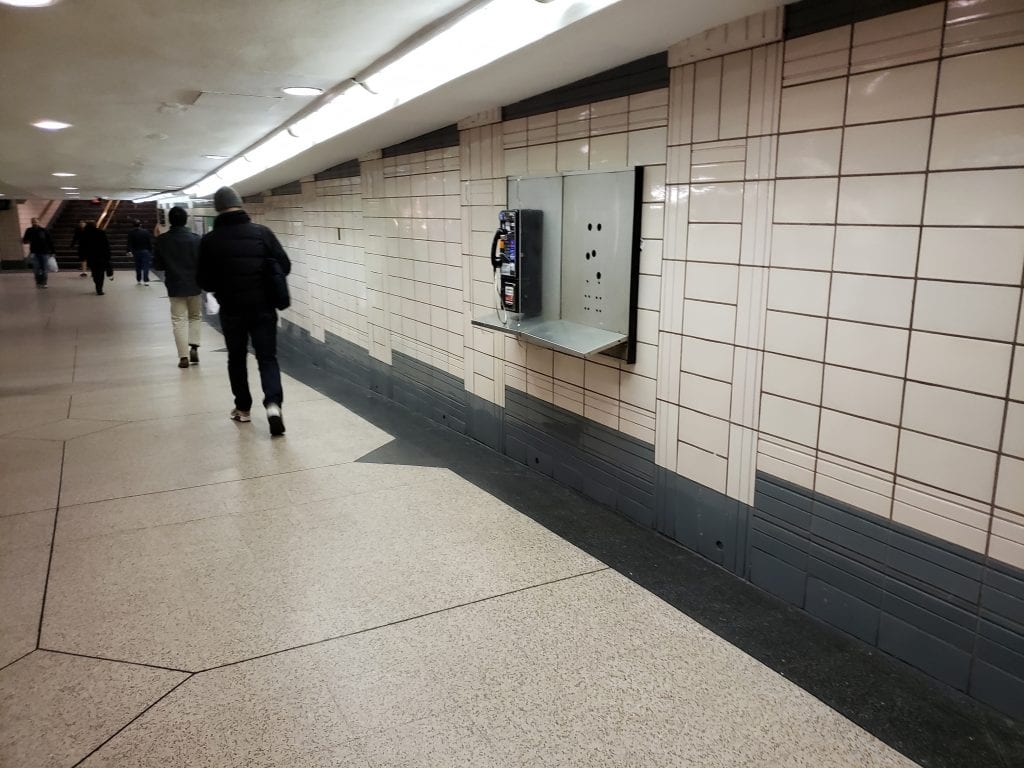
I think there used to as many as six payphone along this wall, with dozens more throughout the Rockefeller Center complex. When I was a corporate mucky-muck I used to work at the Time & Life Building, and I’ve rented Post Office Box 181 at the Rockefeller Center post office since the early 1990s. From my office at T&L I used to call the phones on this wall and patch in other random phone numbers to form patently bizarre conference calls of complete strangers. Those calls never worked out as well the ones I did years later, using Skype. With those calls I patched in one stranger after another into a sound world that started off contentious but almost always smoothed out to where the people just talked. I’d call a payphone at a bar in Beatrice, Nebraska, and connect whoever answered to someone at a random phone number in Chicago. That initial connection of two people was critical since their presence was more likely to lure in whoever I called next. I never recorded these events because I thought recording phone calls without all parties’ consent was illegal. It is not illegal in New York but it could get a little murky with calls made to other states.
Contrary to how quiet it’s been around this website of late I continue to remain very much actively observant of the changing world of payphones, particularly here in New York. I’ve been trying to regroup my energies and focus again on fleshing out the arc of a narrative on where payphones stood in American life and how their function has evolved with developing technologies and advertising-supported subsidies.
But The Payphone Project started as an art project, not a narrative history, and I continue to pursue my use of payphones and public communications devices as conduits for what amount to performance art of the street, where any passing stranger can become a member of my audience. It’s an ephemeral kind of art but it can be electrifying at times, and it has lef me to dip into my inner Joe Frank at times.
I’ve recently discovered that LinkNYC kiosks are more intriguing than I thought in terms of their use as artistic conduits — more on that later.
Much of what I’ve done with the kiosks has only been shared among friends but reactions have been positive and I continue to collect material and try to get organized, a once natural discipline that seems to have become more and more difficult for me over time. My flâneur lifestyle has made me a bit unmoored in my day-to-day routines, or lack thereof. I either abandon or simply forget about far more projects than I come anywhere near completing.
I am also thinking about coming clean on a matter that has lingered over my life for something like 30 years, regarding my entry into the wild and woolly days of phone phreaking in the 1980s, before I even knew the word “phreak” existed. I have never aligned myself with any kind of hacking or what I consider unethical phone phreaking, contrary to what a lot of people out there might have assumed about me based on the subject matter of this website. But before I come clean on all that I’m going to contact one of the many people from that world who I’ve studiously ignored over the years, to see if I really should.