
NYC.gov’s Open Data web site opens a little window into the ever-shrinking world of New York City payphone usage.
By searching for payphones on the NYC Open Data web site one finds summary information for a variety of payphone complaints made to 311 — the city’s non-emergency telephone help line.
2,382 Payphone Complaints were made between January, 2010 and mid-February, 2012. Of those complaints 1,014 reported payphones that had been damaged. This makes “Damaged Telephone” the #1 payphone complaint in NYC.
The #2 payphone complaint comprises 897 reports for lost coins. Assuming callers lost an average of 25¢ each those 897 complaints represent a loss to the New York City economy of $224.25. That seems wholly insignificant until you allow that most coins lost to payphones are not reported to 311 or to anyone else. The dollar amount of money lost to payphones is certainly much higher than $224.25. Thus, on further analysis, the matter becomes only slightly insignificant (Wait. What?).
I have lost a fair amount of coin to payphones, but in reality it works both ways. On Tuesday night I made a call from a payphone on Broadway in Manhattan. After ending the call my coin was returned. Thanks, Telebeam! Last week I picked up a payphone in Queens and dialed a number. The call went right through. I never even deposited a coin. Thanks, Verizon!
“No Dial Tone” is the #3 complaint recorded by 311, but this should be the #1 complaint. Only 160 calls were made to report what certainly outranks lost coins and damaged phones as the most widespread payphone problem in town.
The low number of 311 complaints for such a common problem as non-working payphones is not surprising. It takes initiative for someone who finds a non-working payphone to seek out a working phone (or use the NYC.gov web site) and follow through to report the matter of that non-working payphone.
86 New Yorkers called to report payphones blocking a sidewalk, while a mere 61 complaints concerned what callers described as “illegal activity” by a payphone. There seems to be a conventional wisdom that payphones are magnets for criminal elements and activity. 61 complaints over 26 months would seem to defy such wisdom. Perhaps these complaints are directed more toward 911 and local community boards.
Borough-by-borough the number of payphone complaints breaks down thus, in descending order of number of calls: Manhattan: 1004. Brooklyn: 547. Queens: 490. Bronx: 265. Staten Island: 76.
Inspired by this trickle of municipal payphone-related data I decided to file my own payphone complaint. A Verizon payphone I know of has been out of service for years. I pick it up every once in a while, taking existential comfort in making sure it still does not work. If I am the only citizen who cares then it will be I and I alone who relishes drowning the silence of this payphone with a cool, clear dial tone. I just have to get someone to fix it.
I filed my payphone complaint online in late December. 311 issues are allegedly addressed within 30 days, but 30 days passed and nothing happened. After one month my complaint was automatically flagged as past due. All the while I checked in on the trusty non-working payphone every now and again, in case a stealth team of payphone technicians had been dispatched to restore the dial tone to this mute creature.
There was no joy, for there was no dial tone.
After two months the replies from 311 finally came. (I accidentally sent the request in twice, so I got two separate responses, both essentially the same.)
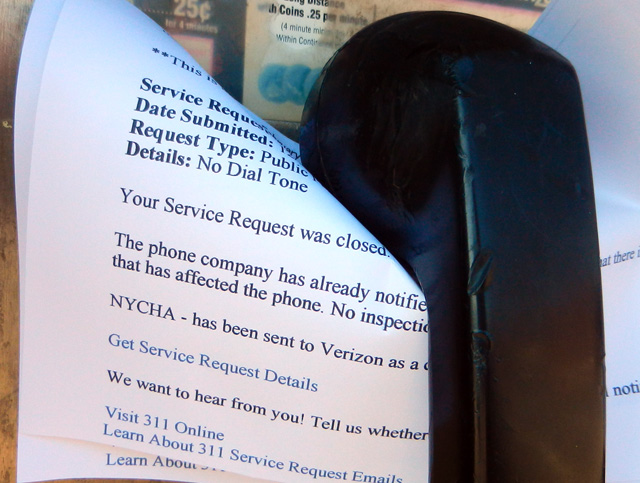
“The phone company has already notified the Public Pay Telephone Unit that there is a long term project that has affected the phone. No inspection is necessary. NYCHA – has been sent to Verizon as a courtesy.” The second reply read “PPT is no (sic) NYCHA property. Will forward to NYCHA and Verizon”.
I don’t know the city’s or NYCHA’s bureaucratic innards well enough to guess what kind of “long term project” has rendered this phone unfixable. “Long term project” makes it sound like progress is afoot, while reality seems to indicate that payphone complaints are mostly ignored. This non-working PPT (Public Pay Telephone) looks perfectly intact, albeit mildly vandalized (maybe I should have reported that, too). I also didn’t expect that the city would consider forwarding the complaint to Verizon a “courtesy.” When I issued this payphone complaint I assumed that the owner of the payphone would of course be notified. Who else is going to fix it?
The response to my payphone complaint came 2 weeks ago, or about 2 months after submission. Today there is still no dial tone at that payphone. I suspect that this phone will be removed before Verizon technicians would be summoned to repair it. I will check in on it now and again, hoping to hear that sensuous sound of the perfect-fourth dial tone, but expecting to hear that depressing vacuum of silence.
But wait. Here is something interesting. According to the Rules of the City of New York, Administrative Code, Title 23 (Communication), Chapter 4 (Public Pay Telephones), Section 23-408 (Violations; Penalties and Other Enforcement):
“An owner who repeatedly fails to provide phone services from a public pay telephone for any sustained period of time or who fails to provide coinless twenty-four hour 911 service from such public pay telephone shall be in violation of this chapter and shall be liable for a civil penalty of not more than two thousand five hundred dollars for each violation which may be recovered in a civil action or in a proceeding before the environmental control board. In the case of a continuing violation, each day’s continuance shall be a separate and distinct offense.”
Two thousand five hundred dollars? Payphone providers can be fined $2,500 a day for failing to fix broken payphones? Wowza. The math is simple: This payphone has been out of service for at least 3 years. At $2,500 a day for this “continuing violation” of failing to provide phone services and for failing to provide coinless 24-hour 911 service from this public telephone Verizon could be on the hook for a penalty of $2,737,500. According to the Rules of the City of New York Verizon owes the city two million seven-hundred-thirty-seven-thousand five-hundred dollars for the continuing violation of this non-working payphone. That amount should increase $2,500 every day for just this one payphone.
(By the way, that Rules of the City of New York site deserves recognition as one of the 21st century’s most obstinately-designed web products. I am no design-virtuoso myself but come on, it’s like trying to access the Internet through a payphone over there. Everything about it is weird, from the IP address URL to the Netscape-enhanced frames interface.)
The city is unlikely to penalize Verizon $2,737,500 for failing to fix this payphone. The litigational logistics of retroactively enforcing this rule (and the apathy of all involved) would lead to no fines being levied.
It would be interesting, though, to see if these rules were ever enforced. It may not have been the case in decades of yore but today these fines, if enforced, could promptly bankrupt any independent payphone provider the city might want to target.
I was unsurprised yet still miffed at the futility of my initiative in trying to get this payphone fixed. I decided to leave a token of my respect for the process. I printed copies of the e-mail responses from 311 and stuffed them under the payphone handset. These papers were gone the next day, but the phone still didn’t work. If 311 can’t get this thing fixed then I guess no one can.
I have had mixed though mostly positive luck with 311. I’ve called to report dead cats, vermin, squirrels, and other freshly-expired creatures. I assume those matters were dealt with by the sanitation department, but for all I know starved hawks swooped in and devoured the carcasses before city animal removal personnel arrived.
I once called to report a bag of dead birds. At the time I thought it an especially strange thing to see on a city street. I later realized that those birds probably came from a nearby Pollo Vivo establishment, where freshly killed poultry and goats are sold to people who like to see what they eat.
Another time I called 311 to report an errant car alarm that had been going off all freakin’ day. In that case the 311 operator surprised me by transferring me to 911. The operator said “any alarm in progress is a 911 matter.” It seemed like overkill to call the police in for something like a malfunctioning car alarm, but the alarm shut off 20 minutes later, so I guess the 911 route worked.
(I wonder if that rule about “any alarm in progress” being a 911 matter includes bedside alarm clocks and clock radios? Some years ago a downstairs neighbor left town for a while. He forgot to disable his alarm clock. It buzzed and buzzed and buzzed, quite loudly, for 2 hours between 6am and 8am every day for a week. Had I called 911 would the police have busted the guy’s door down and smashed the annoying alarm clock?)
Another time I called 311 to report an abandoned vehicle. A month or two later I called again to report the same abandoned vehicle. A month or so on and I called again to report this increasingly conspicuous eyesore. Some of the car’s windows had been smashed, and the vehicle had accumulated dozens of parking tickets stuffed under the vehicle’s windshield wipers.
The last time I called to report this vehicle was when I spotted 3 kids vandalizing the car. They were smashing the car with a bat and rummaging through it looking for whatever treasures they could salvage. When I called 311 this time the dispatcher forwarded me to 911. This is because I was witnessing a crime in progress. I asked (but I went unheard): why can’t we just get rid of the problem of the abandoned car rather than waste police resources chasing after the crime it attracts? As I spoke to the 911 dispatcher I heard police car sirens. I made myself scarce. I had no intention of getting those kids in trouble. Sure, they were being stupid, but ignoring repeated 311 complaints about an abandoned vehicle isn’t so smart, either.