
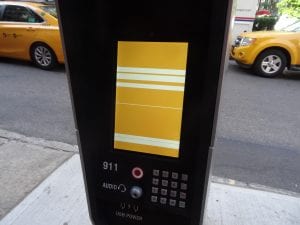
The more I see these things, and the more of them I see, the uglier they become. The stampede of LinkNYC devices up Third and Eighth Avenues, accompanied by their signature encampments of loiterers, has taken on the feeling of an unwanted, unneeded invasion of an already cluttered public space.
If you stand at certain spots near the curb and look up or down the Avenues these Links appear to convene, shoulder to shoulder. They form a cascading deck of visual noise. Their ceaselessly alternating advertisements quietly violate your eyes.
When these things first appeared I was happy to give them half a chance on æsthetic merit. But their numbers greedily increased. They are becoming a caricature of themselves, a ludicrous army of blinking, blistering eyesores.
As the stampede continues the Links have been getting increased attention in the press. Much of the recent coverage is not as suspiciously positive as earlier stories, which were well controlled by CityBridge, the consortium of companies responsible for these monoliths.
Many complaints echo mine: these things are ugly as hell and the loiterers they attract degrade the neighborhood, bringing pornography and public masturbation in to public space. I would not want to have one of these things placed outside my living room window.
The question I asked earlier – When Will the Complaints Start? – has changed. Now the question is When Will the Arrests Begin? Will police start rounding up the loiterers setting up camp at #LinkNYC, making #ClinkNYC a new hashtag? Links are becoming virtually synonymous with homelessness and loitering, and I hate to say it but on account of this I have become somewhat reticent about being seen using one of them. I care nada if some passing stranger sees me using a Link and assumes I am dirt poor, homeless, or watching pornography. I don’t care what strangers think. But people using Links have become a niche laughing stock of social media. To be seen using one could result in images of myself circulating among the picture parade of other Linksters lying spreadeagle on the sidewalk and lounging in their easy chairs — not that I am likely to assume such a comfortable position myself.
Instagram photos by Kevin Oneil.


The Curse of 212-477-3063
I continue to find it troubling that these devices are programmed to send out fake CallerID. Initially each Link device was assigned a unique phone number in the 646 area code. I posted a few of those numbers to this web site. Soon after Links were programmed to send out the non-identifiable (212) 477-3063. That number shows up on the CallerID of anyone who receives a call from any Link device, no matter where it is. I don’t know if this fake info is also sent to 911 operators. If it is then they would have a tough time determining your location, as they are should be able to do in an emergency.
For most people, though, calls from Links are essentially untraceable, making the garish devices a gold mine for prank callers and their ilk.
Accessibility and Americans With Disabilities Act (ADA) Compliance
The Links have also been targeted by a lawsuit claiming that the services offered by LinkNYC devices are largely inaccessible to the blind and people with low vision. That does seem like a bit of a blunderously bad planning, but software developers are probably accustomed to shrugging off such concerns by pointing out that this product is “BETA”. We should all be sick of seeing that word used in the context of the LinkNYC rollout. Matters of public safety, accessibility, and the reliability of a public network have nowhere to hide under the caveat that Links are “BETA”.
Another possible example of ADA non-compliance involves certain of what I call the One Ones. The only One Ones that work from Links are 311, 411, and (I assume because I did not test it) 911. It’s illegal to “test” 911 functionality, though I’d be curious to know if anyone has successfully used a Link to report a 911 emergency. I’d really like to know if dispatchers can identify your location from a 911 call made through a Link’s telephone, and if that location information differs when using the red button.
No 711 Relay Service For you
A notably inaccessible One One is 711, the relay service allowing individuals with hearing or speech disabilities to call others using a text telephone (TTY) or similar device. FCC rules specifically state: “Providers of interconnected Voice over Internet Protocol (VoIP) service also must offer 711 dialing service.” Vonage is the VOIP provider for Links, and information on their web site states that the 711 relay service is accessible through their network. So why is it not available here?
Maybe because there is no way to use it. I actually don’t see how these Links could work with a TTY/TDD, unless CityBridge has some novel approach to connecting those keyboards to the device via the audio jack or the USB port. That likely could not work either, even with an as-yet-uninvented adapter, since the audio jack is strictly for audio output, not input. And the USB port is allegedly dedicated for charging, not connecting to or accessing devices. The only way a TTY/TDD device could communicate with a 711 operator would be through the device’s built-in speaker, which seems just about impossible.
Direct access to 511 is also not allowed, which is unfortunate. 511 is the all-in-one New York State transit information line where automated voices tell you where traffic problems exist, what subway delays to expect, and so on. 511 was one of the best free calls you could make from a payphone before payphone service providers made it impossible to do so. As I mentioned in this story from 2012, only certain payphone service providers allowed access to 511 from their payphones. Today I don’t think you can get direct access to 511 from any of them, but you can access the service if you know its toll-free number: 888-465-1169.
Buggy LinkNYC
And speaking of phone calls from Links I seem to have discovered a slight bug in these devices. It is hard to imagine anything terrible happening as a consequence of this but it makes you ask what else is buggy about these contraptions. As the video below demonstrates, a Link device blots out the phone number as you dial it, showing only the last number. Risks of shoulder surfing come to mind, but the blotting out of numbers after they are dialed seems like a reasonable attempt at security. You can see what number you are dialing without it being advertised in full to passers-by.
As this 1-minute video demonstrates, the bug in this attempt at obfuscation arises if you press the home button at the bottom of the screen while in the call. This minimizes the telephone interface without interrupting the phone call. That’s actually a cool feature. You can multitask and surf the web or look for something on a Google-only map while talking on the phone. There are obvious positive applications of that interface. The problem is that when you return to the telephone screen the number you dialed appears in full on the screen. Extra numbers entered after the call is connected – pin numbers for accessing voicemail, for instance – are not shown.
I have trouble imagining any scenario where this would present serious risks. Would a shoulder surfer lurking nearby go to the trouble of writing down the number and calling whoever you just called to somehow continue the conversation? You never know but it seems far fetched. It does, however, make you ask what other software bugs exist within these things, and if these devices permanently store phone numbers dialed into them.
LinkNYC vs. Link NYC
I don’t know if this reflects more evidence of bad planning or if it’s just selective ignorance, but it seems like CityBridge, before naming their product LinkNYC, should have been aware of the existence of a clothing and accessories company called Link NYC. I don’t know if that company cares about their brand recognition or if this brazen seizure of the name has caused any problems for them. I might just contact those folks and find out.
Emma
And then there is Emma. Emma and I do not know each other but we crossed paths on LinkNYC’s Facebook page a couple of weeks ago. I wish I had made a screengrab of the encounter.
Emma had attempted to use Links to make phone calls. Like me she found call quality from LinkNYC devices to be atrocious. The person you call sounds fine as their voice comes booming through the Link’s loud speakers. But to the person you are calling you sound like R2D2, as your voice gets tangled up in the surrounding noise of the street. The best luck you could have with phone calls on these devices is to scream… So much for the “reasonable expectation of privacy” we could once expect when using enclosed phone booths.
Emma posted a question to the LinkNYC Facebook page asking, in substance, “Why are you replacing working, functional pay telephones with this patently inferior alternative?” She referred specifically to the free phone call feature of Links, not the Wi-Fi or the pornography or anything else.
Her question, which she had a posted a couple of days earlier, looked like it would wither unanswered.
I commented that I agreed. Call quality on Links was horrible when I attempted to use them some months ago. I would rather carry around a couple of tin cans and a mile of string before relying on LinkNYC as a backup “Go Bag” telephone solution.
Neither Emma nor I deserve an answer, it seems. The conversation was deleted by whoever manages the LinkNYC Facebook page.
I sent Emma a note asking if she got a private reply from CityBridge. She probably never saw my message because of the way Facebook segregates messages from people you do not know.
Hack New York City
A full scale hack of this network could be terrifying, and there is no reason to believe it could not happen. I think there is more reason to assume its inevitability then to imagine that no one is willing to take the chance. Each Link contains three cameras, which could be used by hackers (or CityBridge, for that matter) to put virtually the entire city under surveillance. Or the devices could be turned into propaganda machines as ads on the 55” screens are replaced with ISIS beheadings or pornography. The network could be crippled by ransomware which spreads to the devices of everyone connected to the network. These are possibilities which I hope never come to reality.