Earlier this year I submitted a request to the NYC Open Data web site suggesting that the city release its database of PPT (Public Pay Telephone) locations. My suggestion was never approved and appeared to have been ignored. Last night I submitted the request again.
Some who regarded them as irrelevant now may recognize that wholesale routing out of public telephones has created dangers to public safety. I believe this is true not just in large scale emergencies but in the everyday lives of those who simply lost or forgot to bring their cell phone with them and find themselves stranded because of it.

I hope that everyone who needed one was able to find a working payphone after hurricane Sandy knocked out cell and landline service to thousands of customers. This payphone, several feet from a large tree felled by Sandy's brutal wind gusts, survived the storm with its dial tone and functionality intact.

Young woman using a payphone as her infant child looks on. October, 2012. Believe it or not, folks, people still use payphones.

The old urban legend about hypodermic needles being stuck inside coin return slots got a new lease on life when i discovered a sharp object inside this abandoned payphone in Queens.

All phones are payphones. Whether or not you pay for the call a charge is levied somewhere by somebody to somebody else for the privilege of connecting your phone to another telephone. Public Pay Telephones maintain a special distinction among other styles of payphones for their deliberate and stigmatized pay-as-you-go cash-only mechanism.
A summary of recent payphone news looks at stories from San Antonio, Canada, and Brazil.
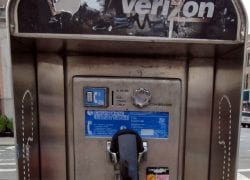
A recent development in New York City payphones probably caught the attention of absolutely nobody but it represents a rare bit of good news for those of us who still use public telephones and whose disaster-scenario planning includes knowing where to find a public phone in an emergency.
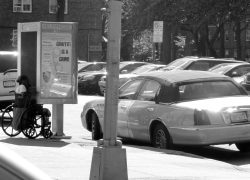
People still use payphones.
For local calls - Deposit 25¢ for 3 minutes, dial number (Overtime is 10¢ for an additional 2 minutes). NOTE: On local calls, over deposits are NOT applied to call.
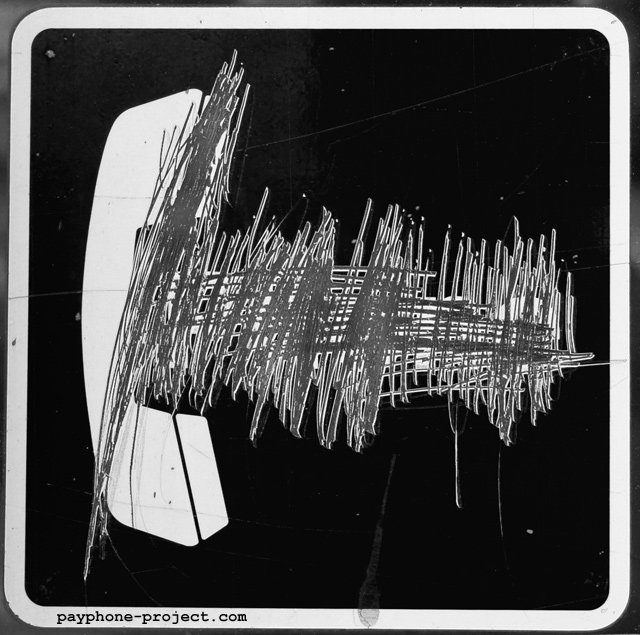
I interpret this vigorous scrawl of vandalism as an expression of the cacophonous noise of silence and an inability to communicate in today's world of public telephones.
It was "invented" in 1877, two years after the telephone itself. Alexander Graham Bell and Thomas A. Watson, his assistant, were making intercity tests which required shouting into the primitive instrument. This annoyed their Boston landlady.
Do Payphones Still Exist? Do People Still Use Payphones? Yes, and Yes.
"The free pay phone is a powerful piece, the equivalent of an art-world bomb aimed at the web of private financial structures that profit from our 21st century need for telecommunicating with loved ones."

The recent announcement that a small number of the New York City's payphone enclosures had been crowned with Wi-Fi antennæ seemed to attract a level of attention out of proportion to its real significance.
Weburbanist borrows a few pictures from the Payphone Project and other sources in this showcase of abandoned payphones.
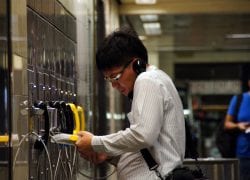
This looks like an image from an earlier generation. The harried businessman, travelling through New York, rushes to a payphone at a busy transit hub and consults his notes, looking for a phone number.
I didn't do it. But if someone appears to have called you from (702) 992-9550 in Las Vegas, Nevada, then things are probably not as they appear. The call could have originated from Sin City but it is far more likely that you got a call from a payphone located somewhere else out there in the United States of America.
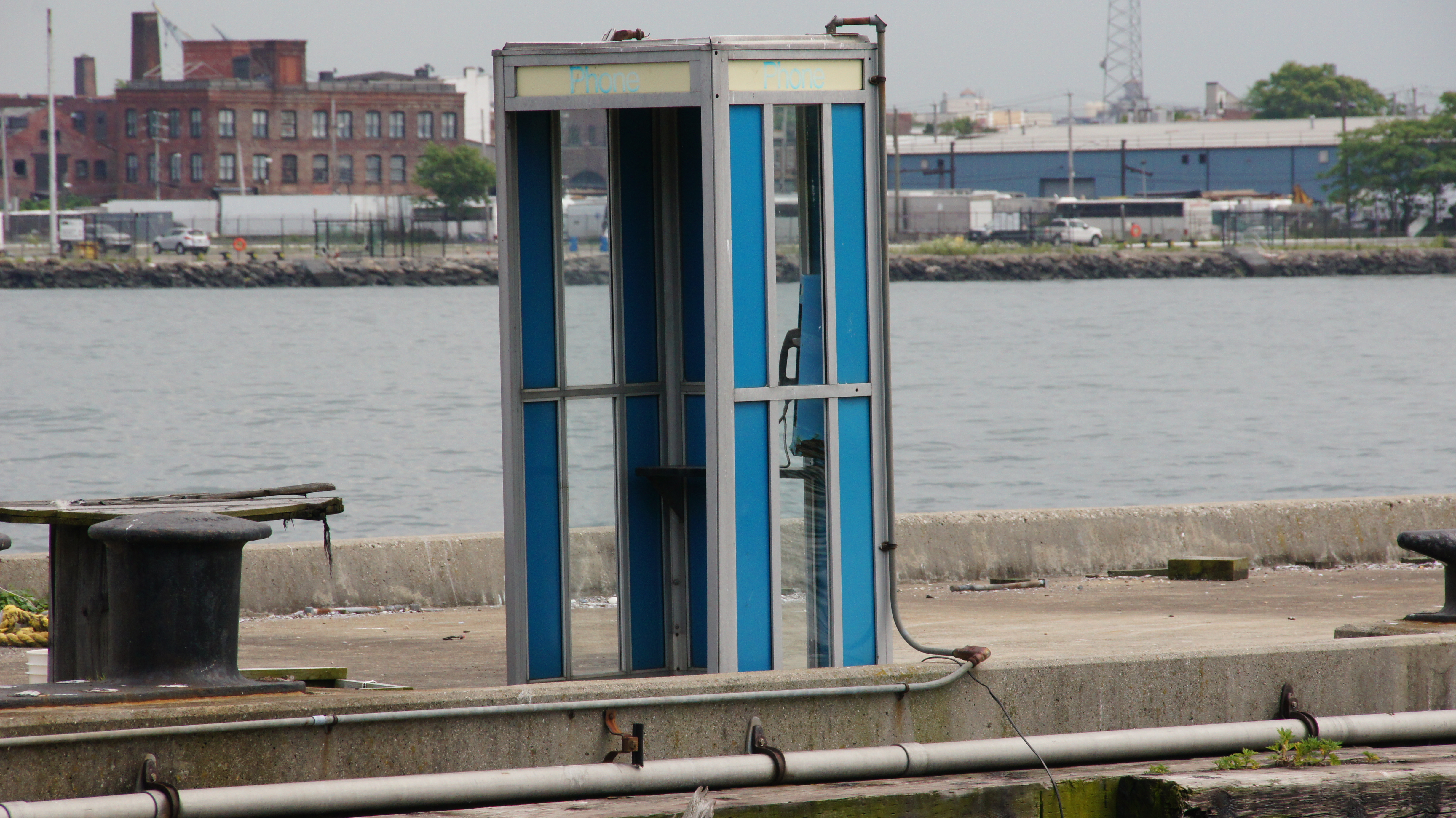
The old phone booth on Yankee Pier is one of the last outdoor, free-standing phone booths in New York City. Its days appear to be numbered. The pier is condemned and slated for demolition. The old phone booth will probably go with it.
A News-Press.com reporter eavesdrops on a payphone in Fort Myers, Florida, reporting on the content of the calls. The story also includes a map of Fort Myers payphone locations and some facts and figures about payphone usage today.
For some reason USA Today's June 10 story about the decline of payphones in the United States includes a photo of a man using a British Telephone phone booth.
Payphones (the ones that actually work) appear to be anything but silent in New York City. Today's payphone user does not fit a single demographic or stereotype. Payphones today are used by children, the elderly, and all age ranges in between.
This is a photograph of 2 human beings using a public pay telephone (PPT) in New York City in the year 2012. (More said pictures to come, because we human beings still use payphones).
“The pay phone previously present at the Kum & Go at 14th and Pierce? Gone. The one on Pierce Street between Gordon Drive and Third Street? Kaput. “That Pierce Street phone was the one used by Linda Talbott, of Elk Point, S.D., the last time she used a pay phone. That came in the early…
Pacific Telemanagement Services (PTS) continues its acquisition of U.S. public pay telephone locations with the purchase of approximately 4000 payphones from FairPoint Communications.
Canada's National Post follows a day in the life of a Toronto Payphone and makes the shocking discovery that the city's phones do get used, they just don't get used much. Nothing surprising there, but read on for some of my experiences in listening in on payphone users.

Nebraska's Public Service Commission requires that every community in Nebraska have one public pay telephone. That decades-old requirement is now being challenged by the companies forced to maintain these phones at significant financial loss.

Something existentially useless about a map showing locations of non-working payphones inspired me to create just such a map. It's a cartographical masterpiece of banal information. I am so proud.