
This payphone survived superstorm Sandy, but a once-mighty tree did not.
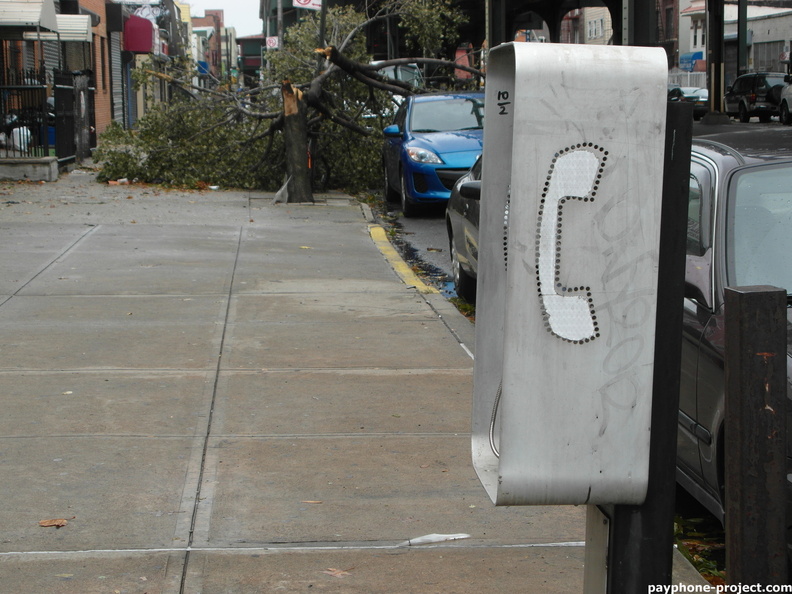
I hope that everyone who needed one was able to find a working payphone after hurricane Sandy knocked out cell and landline service to thousands of customers. This payphone, several feet from a large tree felled by Sandy’s brutal wind gusts, survived the storm with its dial tone and functionality intact.
The Wall Street Journal and numerous other sources add a footnote to the story of Sandy, the superstorm which ravaged large swaths of east coast landscape. The Journal reports that Lower Manhattan finds people in the seemingly ignominious position of using a public telephone to make telephone calls. Some folks, even in these circumstances, simply refuse to do so, choosing to scowl instead at their bricked smartphone while waiting in line for access to a power outlet so they can recharge their device.
People, of course, still use payphones. To suggest otherwise is either ignorance or elitist comment-board snark of the lowest common denominator. According to the city there were some 27,000,000 calls made from public telephones in New York during 2011, not including 911 calls.
All phones are payphones but a definite stigma surrounds paying for calls with coins.
Cell phones and even land lines cannot be relied on after major events such as Sandy, the east coast earthquake of 2011, the blackout of 2003, and 9/11. Long lines of people waiting to use payphones were seen after 9/11 and the blackout, but to me the scarier situation was after the earthquake. As that relatively minor event unfolded I did not see people standing in line to use payphones. I found people looking for payphones and finding none.
As the payphone business has evaporated I think it is time for cities, governments, even public libraries to consider subsidizing public interest payphones and even making them free for limited use.
New Yorkers in these situations are more fortunate than people in other areas. This is a densely-populated city where coin- and calling-card-paid calls generate enough revenue to allow public telephones to survive, if barely. Display advertising on payphone kiosks also subsidizes the business in a city where eyeballs are numerous enough to attract advertiser dollars.
Less populous areas, where payphones commonly made less than $5 a month, have routed out payphones with impunity, creating communication dead zones that threaten public safety when cell phones prove to be unreliable.
I sometimes think it would take a celebrity incident to raise public awareness of the dangers presented by elimination of public telephones. A really famous person will have to lose their cell phone and embark on a futile attempt to find a working payphone, then Tweet their story to the masses before launching public service announcements extolling the dangers of eliminating access to public telephones.
Payphones get fresh attention after incidents like Sandy, but I know that people still use payphones in non-emergency circumstances. As a matter of fact the payphone pictured at the top of this story had a paying customer later in the day:

Sandy has passed but for a lot of people the storm itself was the easy part. Sandy’s impact will be felt for months and even years to come. All my web sites went dark but my problems are insignificant compared to what others lost.