
Citybridge, the consortium of telecom and advertising companies awarded a monopoly franchise to replace New York City’s outdoor public pay telephones with multipurpose “Links”, has taken its first concrete steps in establishing itself as king of the curbside payphone. One by one the company has placed Citybridge-branded informational placards on hundreds, perhaps thousands of payphones owned by Titan Communications, one of the companies which comprise the consortium. The placards (readable if you get on your knees and use a magnifying glass) include information on pricing, how to make collect calls, what calls are free, etc. These boilerplate sheets, which city rules require to be present, are the same as those which appeared on Titan’s phones, just with updated branding and contact information.
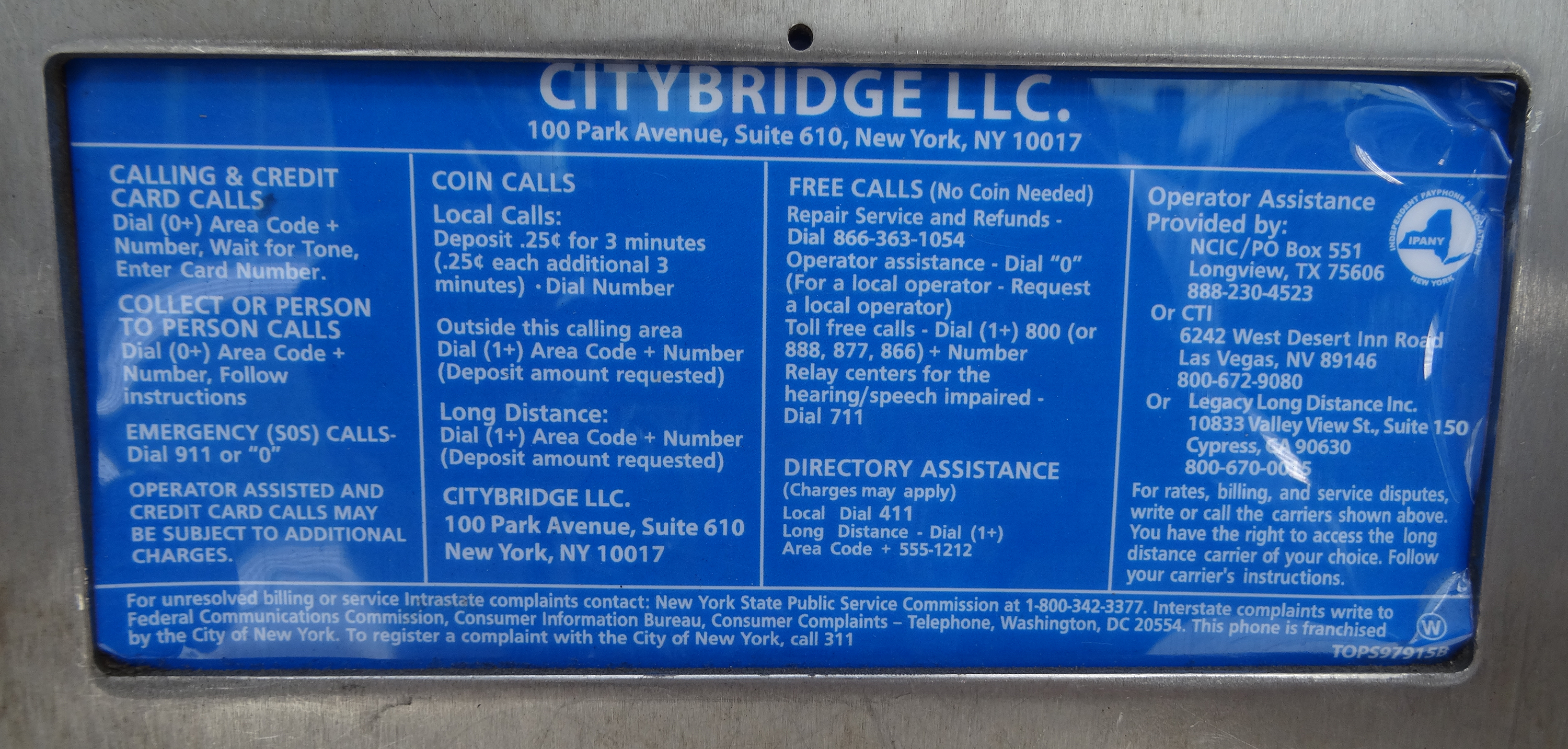
This development, which likely caught the attention of absolutely nobody, might seem curious at first for its attention to and retention of traditional coin-fed payphone devices. One would expect Citybridge to hit the ground running by setting up its much-hyped Link devices and blanketing the city with gigabit free WiFi, as promised.
Alas, an exact timeframe for installation of the first Link devices is still unknown, and the company has said it will take several years to fully replace the city’s 7,000+ payphones with Links — so keep those quarters handy in case of an emergency where you need to make a phone call.
To the best of my knowledge there has not been a single working prototype of a functional Link device presented to the public. Until Link devices actually appear and prove themselves to be the worthy upgrades promised I will be in no rush to “Say goodbye to the Payphone”, as a headline on the LinkNYC web site exhorts us to do.
These placards are also being seen on payphones formerly owned by Vector Communications and East Harlem Unity Communications (EHUC), among others. These companies, which owned relatively small numbers of payphones in New York, were pushed out of the payphone business last year when the city awarded Citybridge its monopoly franchise. Payphone assets of companies such as EHUC, American Payphone, and BAS Communications were purchased for what was reportedly a laughable pittance.
Payphones owned by Telebeam and CBS Outdoor Media have not been rebranded with Citybridge placards. CBS Outdoor Media’s payphones are still branded as Van Wagner, a relic of CBS’s acquisition last year of Van Wagner’s advertising assets.
Citybridge’s branding of these devices is conspicuous for the fact that whoever went to the trouble of placing these placards did not bother to service the phones. Handsets that were busted before the Citybridge branding are still busted. Phones with no dial tone remain silent. It would be unfortunate (but not entirely surprising) if this portends a future in which branding and display advertising take priority over maintenance of a functioning communication network that millions of dollars in promised advertising revenue is supposed to subsidize.
For some reason the Citybridge placard bears a logo for the Independent Payphone Association of New York (IPANY), an organization which, absent any formal announcement, has essentially ceased to exist. The IPANY once boasted a membership of over 100 independent payphone service providers responsible for over 30,000 payphones on New York’s streets. With all those companies shuffled out of business it seems strange that Citybridge would still identify itself with the IPANY or any trade group except for the American Public Communications Council.
Citybridge’s ongoing acquisition of New York City’s payphones represents the final chapter in the history of New York City’s independent payphone service providers, a once-thriving network of small businesses that filled the city’s sidewalks and public spaces with thousands upon thousands of payphones. The relevance of their product faded long ago and most moved on to other things but some payphone owners stuck with their livelihood to the bitter end. It’s been tough to watch.
[Best_Wordpress_Gallery gallery_type=”image_browser” theme_id=”1″ gallery_id=”12″ sort_by=”order” order_by=”asc” show_search_box=”0″ search_box_width=”180″ image_browser_width=”800″ image_browser_title_enable=”1″ image_browser_description_enable=”0″ thumb_click_action=”undefined” thumb_link_target=”undefined” popup_fullscreen=”1″ popup_autoplay=”0″ popup_width=”800″ popup_height=”500″ popup_effect=”fade” popup_interval=”5″ popup_enable_filmstrip=”0″ popup_filmstrip_height=”70″ popup_enable_ctrl_btn=”1″ popup_enable_fullscreen=”1″ popup_enable_info=”0″ popup_info_always_show=”0″ popup_enable_rate=”0″ popup_enable_comment=”1″ popup_hit_counter=”0″ popup_enable_facebook=”1″ popup_enable_twitter=”1″ popup_enable_google=”1″ popup_enable_pinterest=”1″ popup_enable_tumblr=”0″ watermark_type=”none” watermark_link=”http://sorabji.com”]