
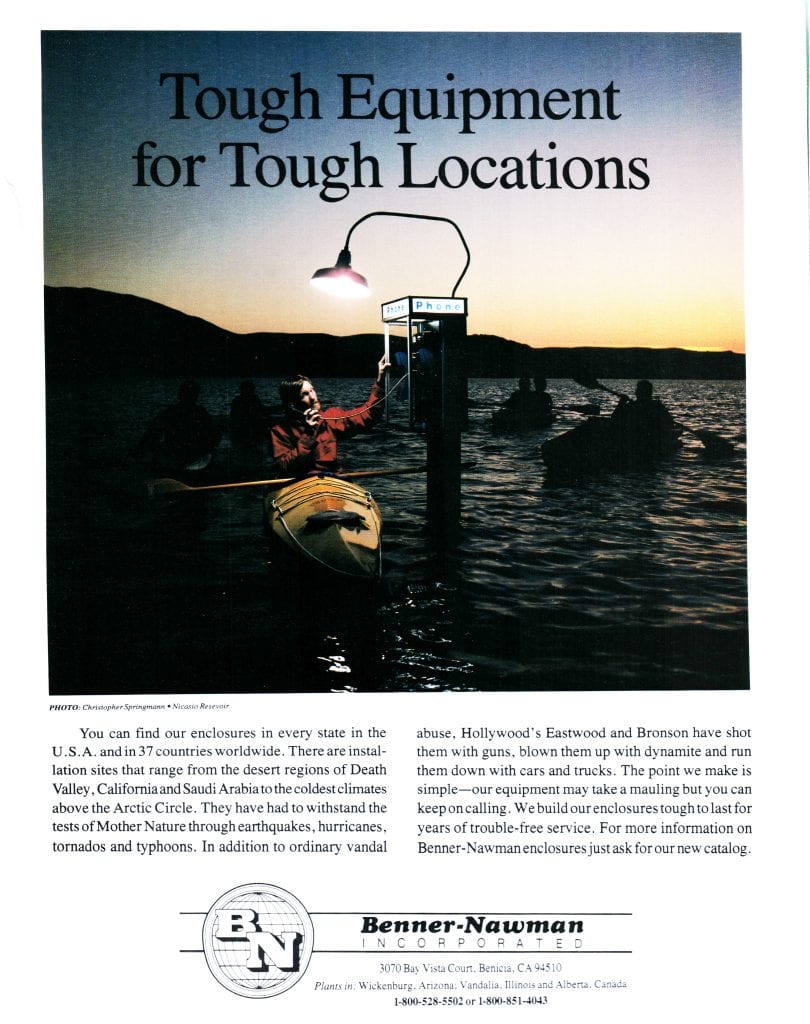
Founded in 1925 the Benner-Nawman company made manufacturing phone booths its primary business for over 50 years. In the 1980s and 1990s the company ran a series of humorous advertisements in telecommunications industry trade journals promoting their “Tough Equipment for Tough Locations.” One of those ads features a standout photo of a kayaker stopping to use a payphone in the middle of the Nicasio Reservoir. The photo is by Christopher Springmann, who I am sorry to say did not respond to my inquiries about this image.
The Nicasio Reservoir payphone photo reminded me of one of the Payphone Project’s more memorable contributions from the early 2000s. The two photos below, contributed by a representative at Remkor Technologies in South Africa, show a fisherman on Lake Victoria in Uganda taking a break from his day’s work to talk on a payphone.


The photos went viral, at least as far as anything went viral in the early 2000s. The images were scooped up by numerous web sites, where a surprising (to me) number of commenters dismissed them as fake. This was over 10 years ago and I can no longer find or even remember the sites where those comments appeared, but I remember them well.
Where did the doubts come from? Were they based on the assumption that the phone had to be hard-wired, and that it would be unfeasible to connect a landline cable to a phone in the middle of a lake? That should not have mattered, since the phone was clearly described as being a solar powered GSM satellite device.
Or maybe folks just assumed technology innovations like this seemed out of whack in a place like Uganda, officially designated by the United Nations as one of the world’s “Least Developed Countries”. Casual observers could be forgiven for not being aware of this but at the time the Lake Victoria photo was taken Africa was at the beginning of a telecommunications revolution. Then, as now, landline usage on the continent was virtually nil (according to Pew Research) but cell phone technology was rapidly bringing connectivity to millions of citizens who had simply never owned or had regular access to a telephone. Pay-as-you-go cell phones proliferated, with “tele-vending” operators charging per-minute rates for calls made from mobile and stationary calling stations. The phone in the photos above was one such device.
See my set of payphone photos from Africa, which includes a number of photos of these pay stations. The photos were contributed by a representative from Tellumat Mobile.
Still, if skeptics thought a landline phone could not be plopped in the middle of a body of water then the Benner-Nawman photo proves them wrong (assuming the photo is not fake). Chris Springmann’s photo pre-dates the Uganda shot by about 15 years, long before solar power or wireless telephony would have been a realistic option for such a location. Nothing about the photo suggests the device was anything but a typical payphone, supplied with electricity and copper landline from under the water.
Then again, if anybody reading this has memories of kayaking on the Nicasio Reservoir in the late 1980s please feel free to share any memories you may have of there being payphones on the water, or of there not being payphones.
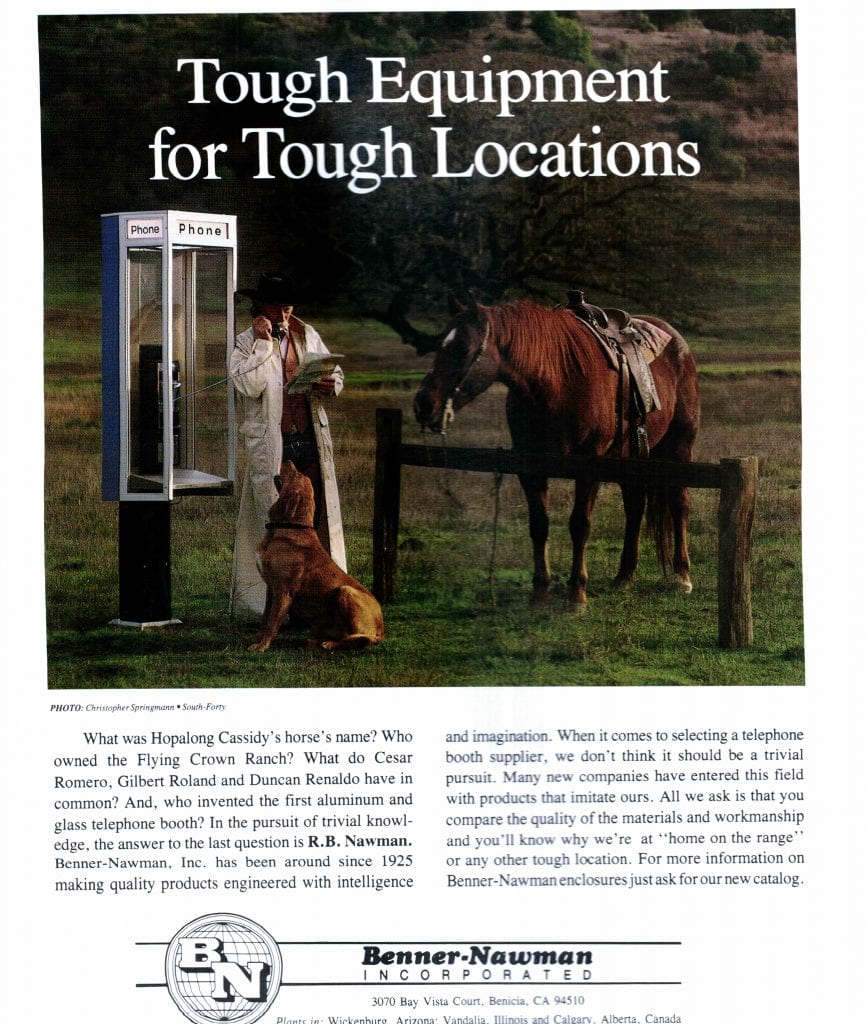
None of the other photos from Benner-Nawman’s series of “Tough Locations” advertisements put payphones in places quite as unexpected as on a body of water. Other ads include a photo captioned “South-Forty”, showing a remotely-located payphone at what I assume is the South-Forty RV Park in Marysvale, Utah. A mustachioed gentleman consults a document while talking on a phone, as a dog and horse listen in.
Another phone outside an Oakville Grocery store does not strike me as a particularly “tough” location, especially compared to the Nicasio Reservoir phone, but I guess payphone abuse comes from a variety of sources. In this case it is implied that some rowdy youth “product testers” are putting Benner-Nawman’s gear through its paces. It’s funny how the girl leaning against the payphone enclosure looks like she is talking on a cell phone.

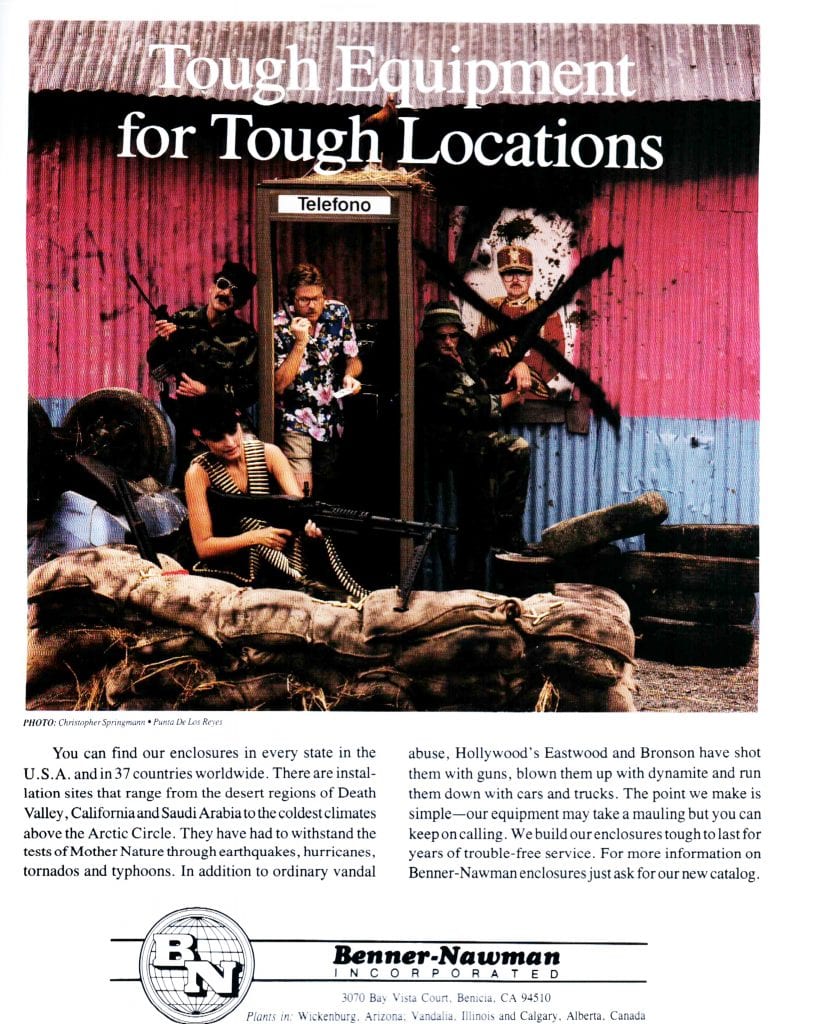
I don’t quite get this last one, which is obviously staged. Captioned “Punta de los Reyes” the photo shows military combatants (obviously actors) surrounding a “TELEFONO” booth as a distressed individual consults a small scrap of paper. My first thought was that this image was attempting to depict a harried war correspondent calling in his story from a payphone, as was common practice among journalists for much of the 20th century. But the scrap of paper in his hand seems too small to contain anything more than a phone number. Whatever joke is intended here is lost on me.
Benner-Nawman was also notable for another payphone curiosity: a rooftop phone booth. In 1967 a UPI Telephoto image showed a telephone booth on the roof of the company’s Oakland, California factory:

BOOTHS EVERYWHERE – The ‘phone people like to brag that you can find a payphone just about anywhere, and this one sitting atop an Oakland, Calif., factory might seem to be evidence of just that. However, the Benner-Nawman firm just happens to be in the business of manufacturing phone booths. – UPI Telephoto.
I do not know how many rooftop phone booths ever existed in America, or if there was at any time a culture for that particular oddity. But the Benner-Nawman factory’s “roofbooth” was not the only example of a phone booth appearing in such a seemingly surreal location. As recently featured on AtlasObscura.com a phone booth remains to this day as a minor tourist attraction in Lincoln, Illinois. Sitting on top of an old fire house the phone in that booth was used to report incoming storms, but its use in that capacity ceased long ago.
The Nicosia Reservoir ad’s copy alludes to movies in which Clint Eastwood and Charles Bronson fired guns at payphones. I am not aware which films by those actors include actual guns being fired at payphones, and I do not intend to catch up on Charles Bronson’s filmography any time soon, but I remember being intrigued at how “The Phone Booth Game” played a central role in Eastwood’s 1971 film “Dirty Harry.”
The Nicasio Reservoir ad includes an amusingly gruff twist on the famous tag line for Timex watches: “our equipment may take a mauling but you can keep on calling.”
Benner-Nawman also manufactured mobile public telephone trailers and a variety of payphone enclosures and equipment. The company split in 2010, and today serves the wholesale electrical market.
UPDATE August, 2019
Read my follow-up story, posted August, 2019: Payphones on the Water? Also, the Nicasio Reservoir Payphone Mystery Solved.