
On nothing more than a semi-informed hunch that they might all disappear soon I got photos of every payphone left at Grand Central Terminal. This happened June of last year. These are not especially good photos, but I guess it’s lucky I got them at all. Most of them are now gone. There were 24 phones at that time, and as far as I could tell all of them worked, or at least had dial tone. These payphones got a good amount of use from me over the years, but my melancholy in seeing most of them get routed touches more on the diminishing availability of a lowest common denominator ability to make a phone call. Today only 4 working payphones survive at Grand Central. A day when zero remain might not be far off.

These phones, for years almost always barricaded in way or another, likely saw little if any use on account of their inaccessibility. These lurked near the entrance/exit to the subway 7, 4/5/6, and Times Square Shuttle trains. The phone numbers were 212-599-8654, 212-599-8649, and 212-286-0960. The posted number of the third phone changed sometime between when this photo was taken and when I got this one 5 years earlier. Back then the number for the third phone on the right was 212-599-8648.

These four phones hung at the end of the Lexington Passage. Like most of the others they have since been replaced with far more lucrative advertising panels. Three of these phones have metal shields around the touchtone keypads. Those shields are neither cosmetic nor do they secure the handset into the cradle any more firmly than without. They were installed to prevent shoulder surfing, a scam common when long distance payphone calls were paid for with credit cards. Callers had to punch in 16-digit card numbers to pay for their calls. Thieves stood nearby and wrote down the numbers as they were punched into the phones. They then either used the credit card numbers themselves or sold access to them for cheap so others could make international calls at a fraction of the real cost. The full price of these calls passed on to whoever’s card number was stolen. With shields in place the numbers punched in were harder for thieves to see, making this kind of theft harder to pull off.
The numbers for these phones were 212-599-8690, 212-599-8677, 212-599-8684, and 212-599-2743

These phones, at the end of the Graybar Passage, were the ones I used most often at Grand Central. The second one from the right had especially recalcitrant buttons. They all had scratchiti etchings that were probably not the work of PRAY but of her imitators. Much of that scratchiti was covered by metal placards advertising collect calls. The phone with the dangling handset had an extremely short cord, not even ½ the length of the others. You had to hunch in to the payphone to hear and speak through the handset.
A memorable incident at this line of phones occurred last summer. I was talking into the fifth phone on the right when I noticed a woman had picked up the third phone and started talking into it. She had not deposited coins or dialed any numbers. What words she spoke that I could hear indicated she was disturbed. I did not want to eavesdrop or invite myself into her world but it was hard not to listen in for some sense of what troubled her. In the middle of this uneasy situation appeared another woman who picked up the fourth phone, putting herself between the disturbed woman and me. She dropped a quarter into the phone and made a call. Moments later another person picked up the first payphone and made a call. With four people in a row all using payphones at once I laughed at myself for asking “What is this, Grand Central?”

These three were across the hall from the Station Master’s Office. Their numbers were 212-599-8638, 212-599-8636, and 212-599-8635. All are now gone, replaced with digital billboards.

Chisel marks, as seen on the left side of this phone, were common across all the Grand Central payphones. Other attempts at scraping out words or meaningful combinations of letters also appeared but not with the determination or precision of PRAY.

This was the only phone in the Terminal with a credit card reader. I never attempted to use it but with its absence I wish I had procured a cheap burner cash card just to see if this thing still worked, and how outrageous the rates would be. In years past I used credit and prepaid calling cards all the time, and just for the hell of it I recently attempted to use an old 2005-era Verizon prepaid card I found in a desk drawer. The calls never went through but money was deducted from the value of the card as if they did. Verizon officially exited the calling card business years ago but the access numbers still survive, even though they don’t seem to work when used from payphones.

These were at the end of the Shuttle Passage. Two of these still survive, or at least they were still there a couple of weeks ago. Their number are/were: 212-599-8630, 212-599-8629, and 212-599-8621.
To conform with the Americans With Disabilities Act (ADA) each of Grand Central’s banks of payphones included one that was lower to the ground than the others, for wheelchair access. This means that the Terminal’s remaining payphones are not ADA-compliant. Lawsuit, anyone?

Payphone numbers hand-written like this are pretty rare. This one is not quite readable, at least not to me, but whatever number was intended to be written does not resemble the actual number of this phone. It’s cool what the urgency and human character of handwritten numbers like this bring to the æsthetic of the device.

These two phones inhabited a part of Grand Central that changes from an ocean of silence to a sometimes raucous stampede of commuters pouring out of Tracks 38 through 42. The curious looks directed at me from individuals in these stampedes who saw me using these payphones were unmistakable. People saw me using a payphone and did a double-take, looking at me with expressions of irony, interest, or just blankness. They might have thought I was poor, a drug-dealer, or some kind of Luddite. Whatever they thought I wish these phones survived today. I have a hunch that if I stood in place long enough on this spot as one mass of commuters after another passed me by I would turn up in a photo on someone’s Instagram or other social media account with the shocking comment that “People still use payphones!?!?!?” I didn’t like using these phones because of those crowds and the curious stares. Now I see where I could have made a meme of myself at these phones.

These yellow handsets with the green “Phone1” logo are relics of Verizon’s last gasp at making the payphone business viable for them. Phone1 was a Florida-based company that knew how to route calls from the U.S. to other countries on the cheap. The company partnered with Verizon and other large telcos nationwide to allow cheap 1-minute calls from payphones to most countries in the world. Affixed to Phone1-enabled payphones might be a placard showing rates to select countries. This placard, which I spotted on a payphone in Forest Hills, Queens, indicates that for 25¢ you could call Chile and other locations for one minute. For $1 more you can get 10 minutes to Chile, 4 to Ecuador, 10 to Canada, etc. Pretty good rates, actually. Phone1’s website with a complete rate sheet survives at Archive.org’s Wayback Machine. Today the yellow handset and Phone1 logo have no particular significance. Phone1 later rebranded itself as Celexpress, and appears to have folder altogether.

Verizon kicked off the Phone1 partnership by giving all visitors to the Empire State Building a quarter they could use to make a 1 minute call anywhere in the world using the payphones on the observation deck. Here is one of the payphones that used to inhabit the Observation Deck of the Empire State Building. This photo is from June, 2002, which predates placement of the yellow handsets in November, 2002. Today no public telephones exist anywhere in the Empire State Building.
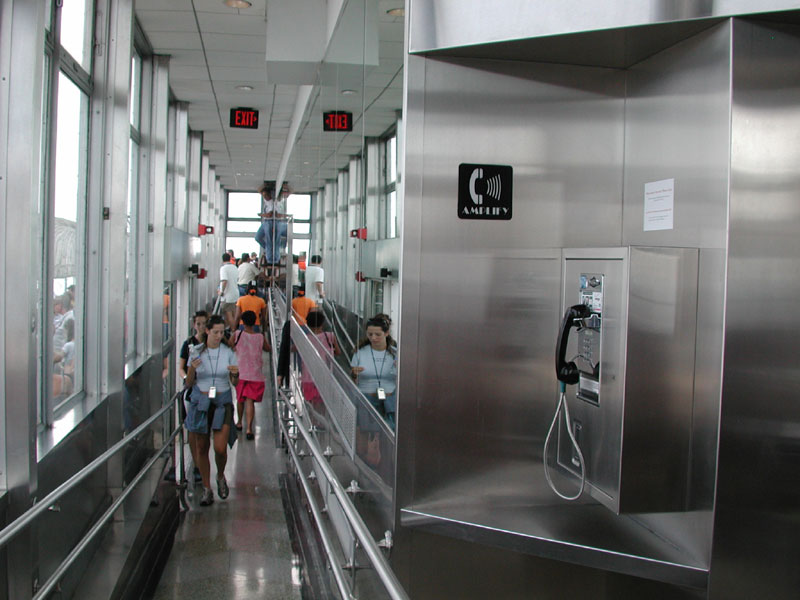
I can’t find it now but I swear I read somewhere that the announcement of the Verizon/Phone1 partnership was further embellished with dozens of Verizon/Phone1 branded balloons cast into the sky. It’s hard to imagine such festivities surrounding anything regarding the world of payphones today.
 Grand Central Terminal, Payphones Gone

As many as 11 payphones used to line this wall. Within the past month the last of them disappeared as did all of these metal surfaces. This wall now looks the same as the rest of the Terminal’s empty walls. As much as I wish one of these phones survived on account of its location so visible to thousands of daily commuters I will concede that this wall of mostly vacated payphone stations looked pretty ugly.

These phones were hidden in the Station Master’s Office. The one on the right still remains, with its TTY/TDD device that probably does not work. These devices are used by the deaf and speech-impaired to make phone calls using a physical QWERTY keyboard that would emerge from behind this metal door. These devices are interchangeably referred to as TTY (Tele-Typewriters) and TDD (Telecommunication Devices for the Deaf).


The phone with the only TTY at the Terminal is also the only one with the yellow placard covered with 3-button shortcuts to call a variety of phone numbers, including a daily prayer, some banks, and a job hotline. I am not religious but I have dialed *10 from phones like this and felt enchanted by the experience. If you find a payphone like this and dial *10 then be prepared, you will be talking to a live person, not an automated or recorded message. The prayer line does not have posted hours of operation but in my attempts it seems to only connect with a live person during normal business hours.

This phone in the basement remains and still works. It is near the Lost & Found.
That’s it for this tour of Grand Central Terminal’s payphones, most of which are gone. Only four remain, though they could have disappeared in the time it took me to write this, leaving segments of society out of touch in a facility where I think a lowest common denominator of public communication should not be considered optional. Payphones not included in this survey include the ones in the Grand Central subway station, and a lone phone found in the Northeast Passage. Those phones have been out of service for years. Two non-working payphones also occupy the bathrooms at the Grand Central Oyster Bar Saloon.
This removal of payphones is unrelated to the LinkNYC program, which aims to replace all outdoor payphones with horrible “Smart City” kiosks. All of New York’s outdoor payphones are owned by CityBridge, which enjoys a monopoly franchise on both public pay telephones and their LinkNYC kiosks that will replace them.
Payphones at indoor facilities such as Grand Central, Penn Station, and various Broadway Theaters are almost all owned by Pacific Telemanagement Services (PTS), the nation’s largest payphone service provider.