
Having watched the precipitous decline of public telephones in New York City and throughout the United States I found it strangely gratifying to visit a town where the payphone infrastructure is, by comparison, frozen in time.
A vacation to Montreal, Quebec, turned up payphones in quantities and distribution similar to those found in most U.S. cities a decade ago.
Banks of payphones line the walls of shopping malls, subway stations, the airport, and most public locations.
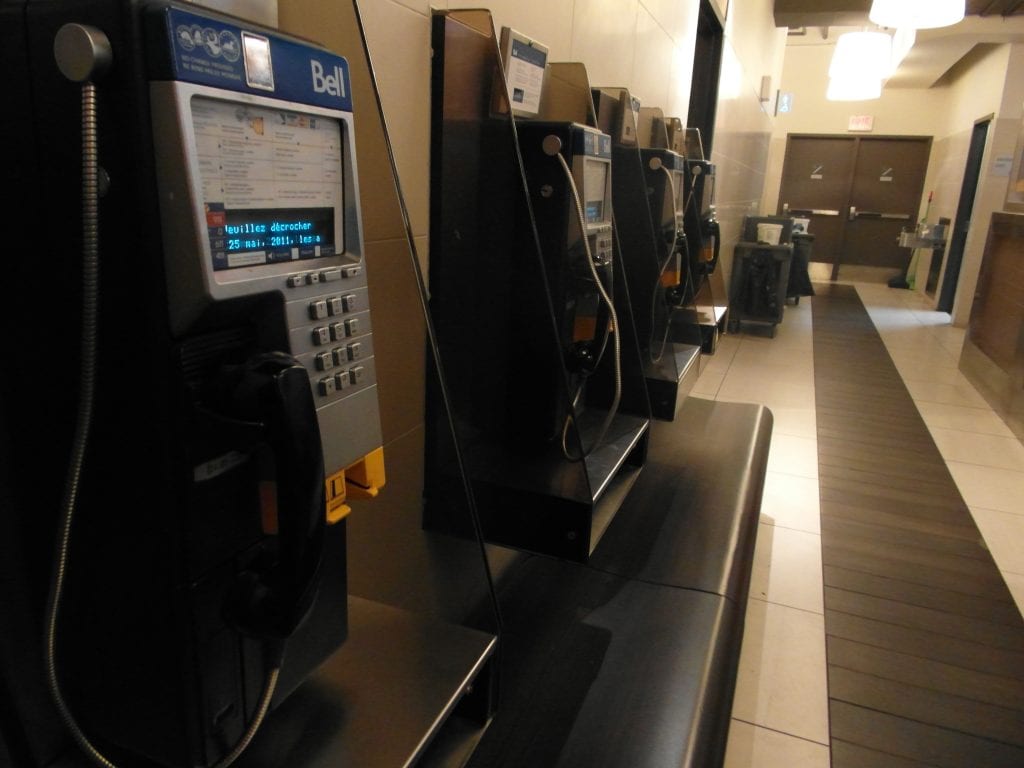
Bell Canada’s corporate logo is virtually everywhere in Montreal, crowning tops of phone booths and smaller payphone enclosures everywhere from busy city streets to relatively untrafficked indoor locations at restaurants, pubs, and college cafeterias.

Many of Montreal’s payphones are complemented by another virtual antiquity: telephone books. Copies of the Yellow Pages and White Pages (albeit years out of date) hang from plastic folders, probably serving little use but at least fulfilling the appearance of public telephones’ relevance.

Most notable to this observer was the abundance of payphones and handicapped-accessible QWERTY-enabled TTY/TDD devices in Montreal’s underground subway system. In contrast to Montreal New York’s subway stations have experienced a near elimination of working payphones and handicapped-accessible communication devices over the last year, a decline which public officials seem uninterested in stopping even as public safety and ADA-compliance considerations become obvious. The inability to simply make a telephone call from those spaces is not just irritating but potentially hazardous.
As if to prove my point I spotted this scene in Montreal, unlikely to be witnessed in New York: Police activity at the Berri-UQAM subway station disrupted train service for a good period of time, forcing dozens of passengers (a lot more than shown in this picture) to head to the payphones to contact whoever might be waiting for them.
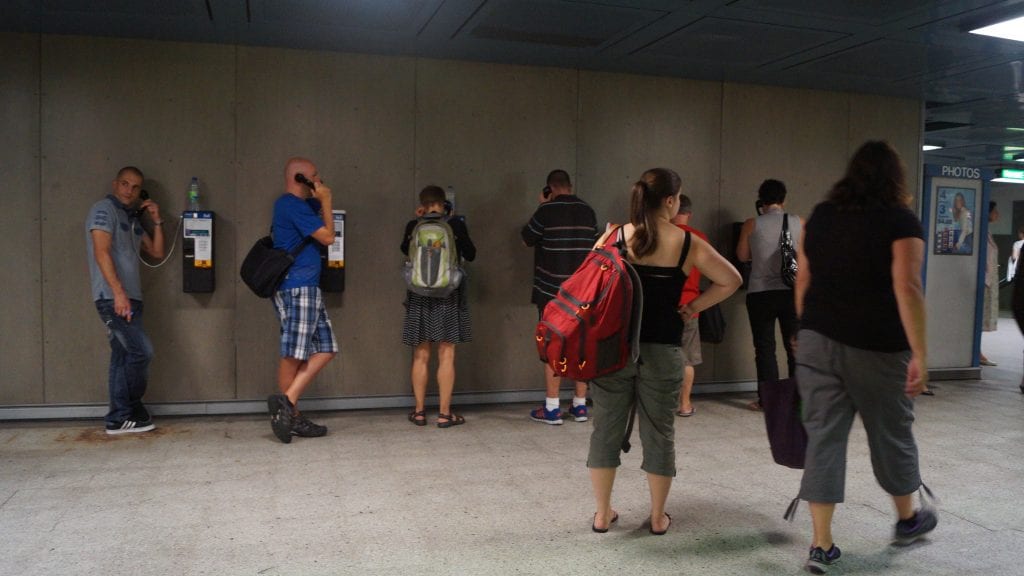
This scene would probably not occur in New York City because most subway stations here have zero working public telephones. Emergency callboxes exist but such devices are not suitable for simply making a telephone call, and few passengers would think to use them even in truly perilous circumstance.
I never got the skinny on what caused the service disruption at the Berri-UQAM station, but it appears to have been a minor incident as train service quickly resumed.
For a brief minute, though, I was reminded of the long lines that formed at payphones after 9/11; after superstorm Sandy; after the Blackout of August, 2003; and I was reminded of the confusion and search for payphones that occurred after the earthquake of 2011.
If technological fetishism and cultural biases have their way there will be virtually no means of communication available to ordinary citizens after the next major disaster. But disasters come in all shapes and sizes, big and small and everything in between. You might also have a hard time making a phone call if you get mugged of your smartphone or if your phone’s battery simply dries up.
New York’s lack of public telephone communication in its subway system has the potential to create dangerous situations, but the matter seems unlikely to attract concern from the city or MTA simply because there is no money at stake.
Therein lies the dichotomy of the public telephone business today: Contrary to public perception the city is interested in keeping payphones on its streets, but the interest stems mostly from the millions of dollars earned through advertising revenues and enforcement of fines.
But the MTA’s subway payphones are contracted separately from the city’s outdoor kiosks. Without billboard-style space on which to place advertisements the subway phones earn virtually nothing, relying entirely on money made from coin-paid and credit-card calls. The cost of maintaining these phones is simply a matter of good money chasing bad, and they might just disappear altogether unless subsidies can be devised.
In the meantime the city is forced to maintain a useless network of Emergency Callboxes at costs exceeding $10,000,000 a year. That relatively insignificant amount of money and resource could go a long way toward subsidizing a public telephone network, but instead it goes to a service which probably would not even work if one attempted to use it to report an emergency, and which is of value to absolutely nobody.
Public telephones in America continue to suffer under the stigma that they must be profitable to be relevant. Their reputation suffers further as public perception is guided by ignorant assumptions that only the most unsavory elements of society still use pay telephones.
Canada’s government (for now, at least) maintains that public telephones should exist in the public interest, particularly in areas with poor cell phone reception. (Read more at The Torontoist.) If Bell Canada had its way it would abandon this business altogether, as did Verizon, AT&T, Sprint, and other larger telcos in the U.S. As gratifying as it was to visit a city whose government recognizes the value of public telephones I fear that Canada will follow the lead of other countries and simply let this network go.
I thought this image made for a nice tableau. On the left you have two friends communicating the old-fashioned way: conversation. In the middle a younger gentleman checks his smartphone, as a group of youngsters huddles into the phone booth to make a call from the payphone:

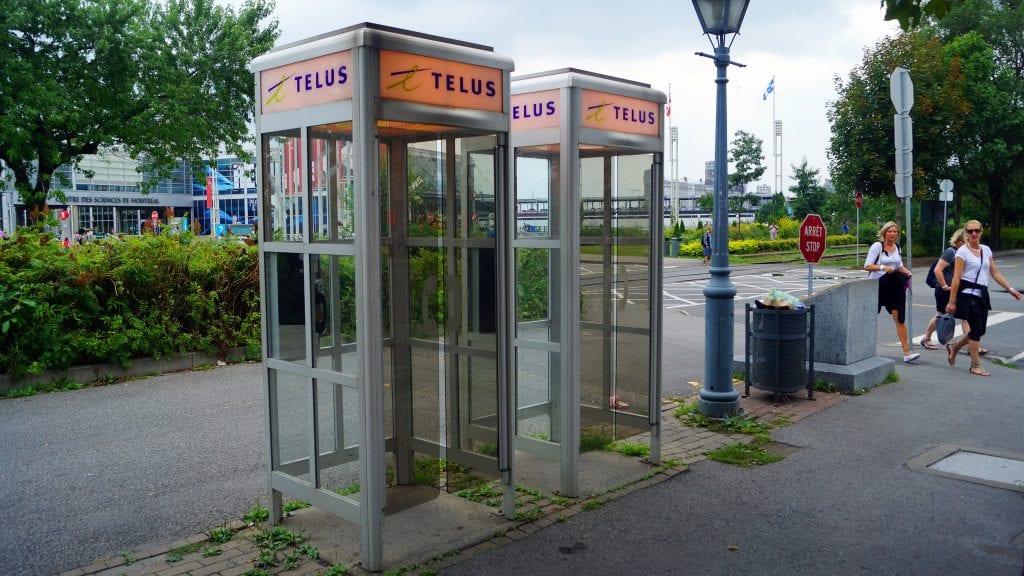
Most of the phones I saw were owned by Bell Canada, but I spotted this pair of Telus-owned booths at Rue De La Commune and Boulevard Saint-Laurent.
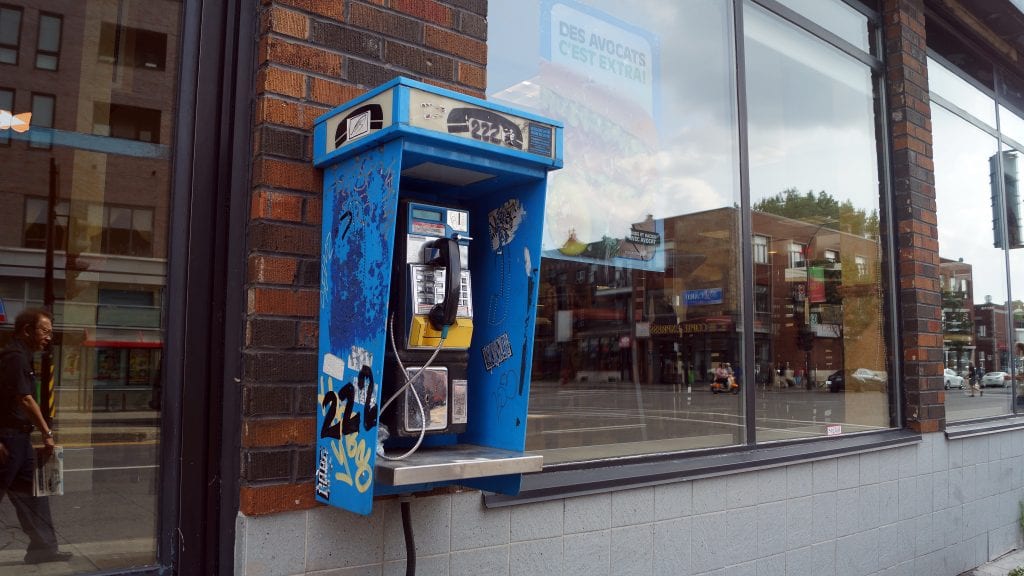
The only COCOT I spotted was this grubby old thing at 404 Rue Jean Talon, owned by AFX Communications:
My visit to Montreal offers mostly anecdotal evidence, but it appears that Montrealites today use payphones just as much as New Yorkers. See for yourself by browsing through my set of Montreal Payphone and Phone booths, August, 2013.
thank you for this discussion.
i am trying to find out whether public phones are plentiful in Montreal now, in 2019.
I did a quick Streetview tour of Montreal, looking for the phone booths seen in the photos I got in 2013. Streetview imagery is current as of late 2018 for most of Montreal. I’d say roughly ½ of the outdoor payphones and phone booths I photographed are gone. I know that’s no authoritative analysis but from where I’m sitting it’s the best I can do 🙂
I really need to find a public phone in Montreal, does anyone knows where I can find one in downtown Montreal in 2020 please?
Bonaventure metro station had a bunch.
Now where I live, up in Saguenay, the only payphones I know of are inside the nearest hospital, there are 4 in there, the free one in the ER waiting room having been disabled “for sanitary reasons”, despite everyone who’s inside an hospital these days, especially a waiting room is gonna be overwashing their hands.
The 2 outdoor ones I knew of, one at the nearest convenience store, which is much more popular than its size in quantity, had the phone booth outside removed when they bought a couple apartment buildings in the back, tore down them too, because they are expanding, dramatically.
The other one was where an old Tim Horton’s used to be, they tore down the building eventually but the phone booth remained.
I hate smartphones, they are tracking devices more than anything. I love desktops and am fine with laptops. I don’t need more than my music-lover smartphone with 32gb of space for mp3, it’s a Phillips so it sounds great and I can remove the battery and sim card from it, the only thing that I got with it that’s a bit advanced is sms lol.
Payphones can be lifesavers. The mountain highway from my town to Quebec City used to have red signs along the way saying “S.O.S.” with the icon of a phone saying 10km 5km then one with an arrow pointing to the payphone. Now that the whole highway has been turned into a 4-lane separated highway, they got rid of them all. Except at the service point in the middle of the road where there’s a gas station, restaurant and convenience store. There’s 2(!) phone booths next to another outside and another one inside the gas station.
It’s a shame when things like smartphone service can be cut off suddenly for many reasons. It’s no different as wifi internet at this point. Hardlines outside for the public is good. Once in 2006 I would have slept outside had I have no change on me to call again and again at my friend’s student apartment/dorm (it’s apartments exclusively for students of the university he went to), because I would have had to sleep outside in downtown Montreal. I was pretty new in town and the subway was shutdown (was past 1:15 am) and I was still unfamiliar with night buses, had no way to get home.
Some crimes are resolved thanks to 911 calls made on payphones. They shouldn’t be removing them more than they have now.