
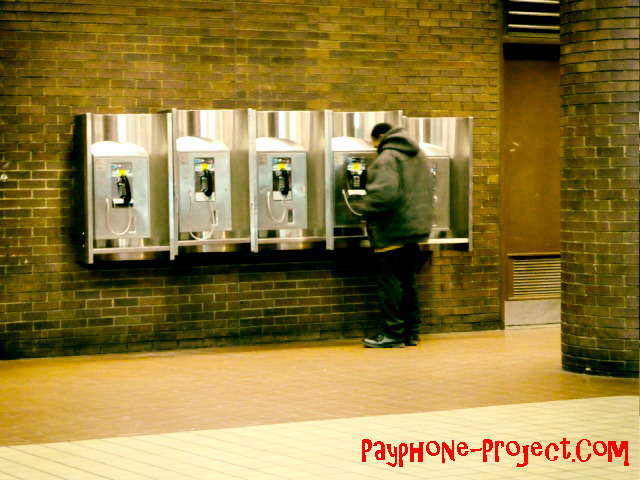
Seeing the man in the photo below use a Port Authority Bus Terminal payphone yesterday reminded me of a paper I read some years ago: “Eliminating Pay Phone Toll Fraud at the Port Authority Bus Terminal in Manhattan,” (link to PDF copy) an essay comprising pages 93-116 of the book “Preventing Mass Transit Crime” published in 1996 by Criminal Justice Press. The essay, written by Gisela Bichler and Ronald V. Clarke, offers a summary account of the seedy world of payphone hustlers, shoulder surfing, and toll fraud that once infested the Port Authority’s payphones.
In the early 1990s the terminal’s payphones were the scene of what sound like positively raucous mobs of people exploiting opportunities to make calls overseas for free. Records showed that thousands upon thousands of calls from the Port Authority’s payphones went to virtually every country in the world, to countries like Gambia, Panama, and Kuwait, with average duration of these calls running as high as 72 minutes and some calls lasting hours. These calls brought millions of dollars in revenue to the Port Authority, but were largely to blame for the “lawless and unsavory atmosphere” at the terminal. The essay concludes that pride, not profits, informed the terminal’s management decision to police the phones and exorcise the criminals. It’s a good read for anyone interested in police theory, and an eye-opening window into what a different role public telephones once played in city life, both in their legitimate uses as well as criminal.
When the “Pay Phone Toll Fraud” study commenced there were 347 payphones at the PABT, a substantial quantity even for a heavily trafficked transit hub in the pre-cellphone days. Despite this teeming abundance of phones there were virtually always long lines of people waiting to use them, even during off-peak hours and weekends — this largely on account of criminal toll fraud activities.
Today there are probably about 100 payphones at the PABT, all owned by G-Tel Enterprises, and the throngs of people waiting to use them are a distant memory. By April, 1992, when the payphone hustlers had been routed out, a survey of 24 payphones at the Port Authority revealed that an average of 344 calls were made per day from those 24 phones, with calls averaging 4 minutes. Today’s average number of calls would, needless to say, be significantly lower than that.
Still, transit hubs such as airports and bus terminals are among the few venues today where payphones maintain some shred of mainstream relevance. On this day the man in the above photograph was the only person I saw using any of the Port Authority’s numerous phones, but I have noticed that the PATB’s payphones seem to stay relatively busy (by today’s standards, that is).
