
I never thought I’d see these things again. But there they are, in Times Square until early September. These three booths were among the last classic American Airlight style phone booths in Manhattan. For a limited time they are back on the streets, complete with payphones and plastic covers for phone books.

But don’t expect to make phone calls with the phones, or to look up anyone’s number in the book. These phone booths, formerly found on West End Avenue, are now part of a piece called Once Upon a Place, by Afghan-American artist Aman Mojadidi. Mr. Mojadidi wired these phones to play back audio recordings of immigrant stories told by New Yorkers who came to America from afar. The phone book holder contains a printed volume with further background on some of the stories heard through the phones.

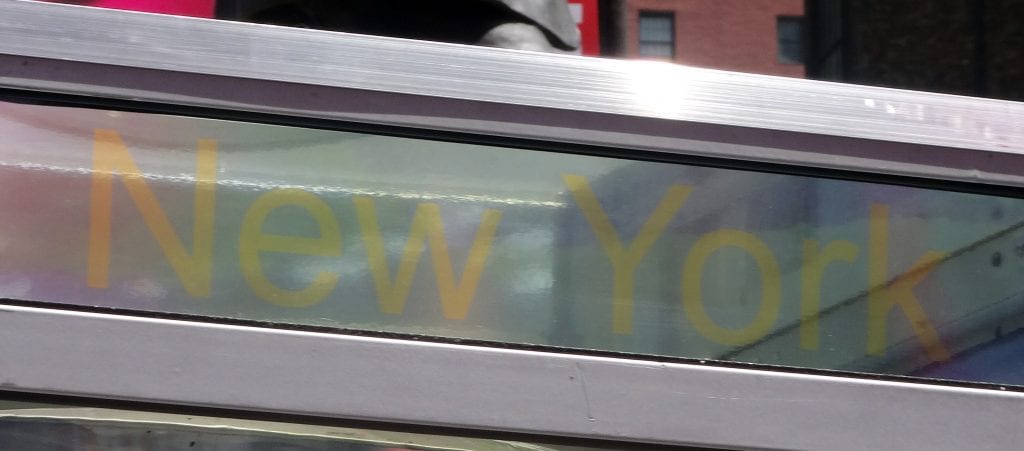
The tops of the phone booths used to read “VERIZON” and then “TITAN”. Today they say “New York” in several different languages.
A number of media sources have written about the project. The best of them seems to be Artnet, which offers this detail on how the booths were procured:
“Mojadidi picked up the retired booths from LinkNYC, where they had fallen into disrepair, full halfway to the top with dirt and garbage. After a careful refurbishment—he had to manufacture new doors, and replace the missing phones—the booths are back in business…”
The phones are “back in business” but they are not wired to the telephone network nor can they make calls. They can only play back prerecorded audio from Mr. Mojadidi’s interviews with some three-dozen immigrants living in New York.
Today the doors on these booths open outward. The original doors on these booths opened inward, as seen in this image. That opening-inward feature was one of the many annoying things about phone booths. The clumsy process of pulling the door toward yourself made it awkward and even dangerously difficult to get out of Airlight phone booths. That design choice is a space-saving move from the early days of public phones, when phone booths were found almost entirely indoors. The door opened inward to save floor space at the place of business where the booth was located.
The overhead lights and fans were replaced with what looks like a magnifying glass. If that is what this is then it might explain the heat. It was not especially warm yesterday but the booths got hot as hell after just a few moments inside with the door closed.

I tried to prop the door open but for some reason I had a hard time doing that. The discomfort from the heat aligned with my memories of phone booths as claustrophobic, stuffy, suffocating coffin-like compartments that people were more anxious to get out of than they were eager to step into.
The graffiti that graced these booths on West End Avenue has stayed with them, unmolested on their journey to Times Square. Besides the phones inside these booths the graffiti was actually the most familiar thing to me about them.

Others will disagree but on first glance I find that these old structures, recovered from a Citybridge trash dump, cut a hoary, almost dumpy profile in the mostly-squeaky-clean environment of Times Square. That’s not to suggest I am unhappy to see them, though:

Aside from my interest in the booths I had a hard time connecting with the intended substance of the project. When you step into one of the booths you hear the sound of a ringing phone. You pick up the phone (because who can resist?) and hear the voice of someone from New York telling their immigrant-related experiences. Most of the stories I heard were in languages other than English. Others were just hard to understand but I was in a bit of a hurry and will give the calls another try on my next pass through Times Square. I should try it after dark when cooler temperatures might make it more inviting to stick around a while.
As discussed several times at The Payphone Project the last phone booths of Manhattan are found on West End Avenue at 66th, 90th, 100th, and 101st Streets. In early 2016 the old Airlight booths now in use for this Times Square display were replaced with newer Canadian models. To me this was one of the more bewildering attempts at a public relations stunt by Citybridge, the company responsible for the city’s remaining outdoor payphones. Coming just months after a particular Airlight booth in Prairie Grove, Arkansas, had been designated a national landmark it seemed like the spirit of saving iconic American phone booths such as these had at least a little momentum. Arkansas is a long way from New York but the story made national news and it seems like Citybridge might have tapped into the spirit of preserving authentic American phone booths by setting up landmark-worthy Airlight structures in Manhattan. In using Canadian models they might as well have put out red British K6 phone boxes (more on the subject of K6es in NYC in a future posting).
The actual payphone devices in the booths at Times Square are not the ones that had occupied the booths when they were on West End Avenue. Those phones remain where they were, in the newer Canadian-style booths. Only one of the phones in the Times Square display shows a telephone number: (212) 874-7993 was, according to this site’s archive of past payphone locations, at one time located at the NYC Department of Finance on the 6th floor of 151 West Broadway.

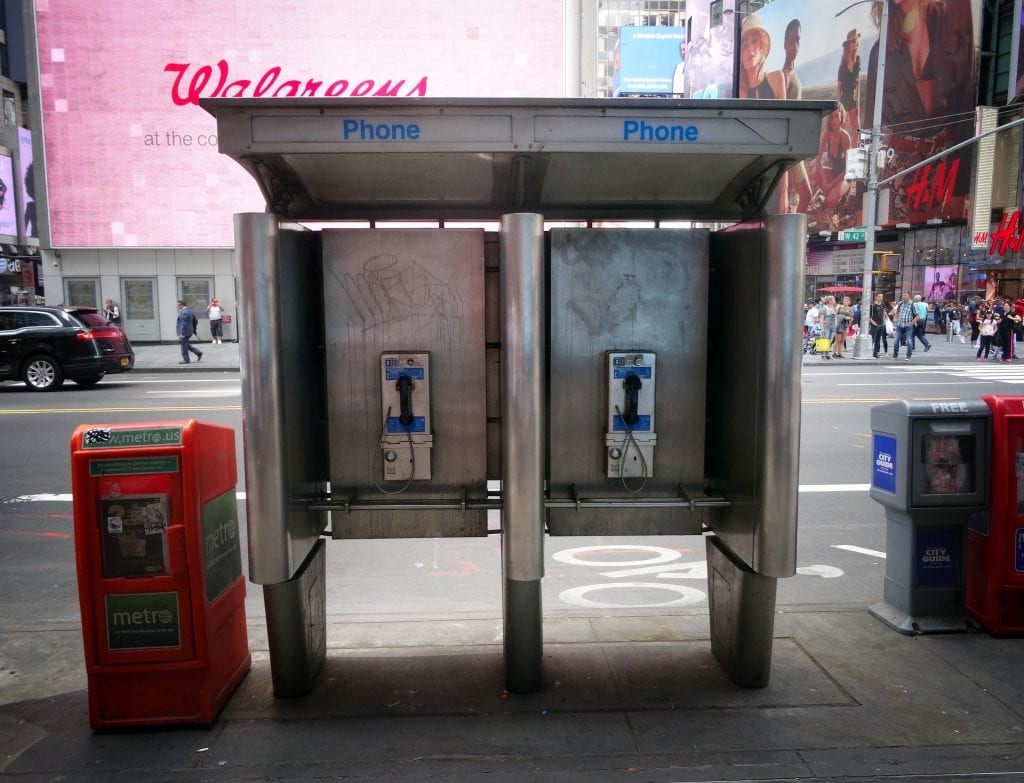
There are still a handful of real working payphones in Times Square. From my observation there appear to be 5 working phones in the area. Until sometime around September of last year there were maybe 2 or 3 dozen of then lurking within the “Crossroads of the World”, a supply of phones far in excess of demand even for that well-traveled area. Most of those phones were routed to make way for LinkNYC devices, the so-called “payphone of the future” loved and adored by the people who made them any by pundits who have never used them. The remaining traditional public pay telephones include one at 48th Street just west of Broadway, two on Broadway near West 47th Street, and these two outside the subway station on 42nd Street:
There are also 6 or 7 payphones found in the underground Times Square subway station. Some of those phones work, some of them do not.
I’ll have updates and better pictures for this story in the coming days.
I have been fascinated by phonebooths since a child when going to the rundown Steinbachs department store in Asbury Park NJ which had rows and rows of the old wooden telephone booths many of which did not work. Recently the museum I work at was able to get a wooden phonebooth circa 1930’s (it was the only public phone and was first in a store that later became a bar sadly the phone is no longer with it Is there a company that refurbs old payphones such as in the ‘Once Upon a Place’ project? Our small museum has a wooden phone booth circa 1920/30’s and we are looking for a payphone so people can dial and listen to recorded stories from our oral history collection.
Thanks 🙂