A sighting of a public pay telephone is sometimes compared to that of the mythical unicorn. If that analogy adds up than how endangered is the payphone maintenance and repairperson, that rarest of individuals whose job is to make sure these phones actually work? The ratio of payphones to repair personnel must be at last 100:1, if not ~hundreds:1.
Here is one such individual, liquid sanitizer and cleansing cloth in hand, working the innards and outards (?) of a New York City payphone enclosure:

Maintenance and operation of New York City’s public pay telephones – the ones franchised by the City, that is – is probably not the responsibility of who you might think. Indeed, many people I’ve spoken with assume payphones found on sidewalks of NYC are maintained by Verizon, The City of New York, or some municipal or even federal entity. Others assume they are not maintained at all.
Nope. The big telcos, such as Verizon, AT&T, etc., exited the payphone and calling card business years ago, leaving the spoils of their payphone assets to a myriad of independent companies large and small. Today’s payphones are mostly owned and managed by private, for-profit companies, ranging in size from single-person operations (East Harlem Unity Communications, BAS Communications, etc.) to well-heeled and deep-pocketed entities such as the one which employs the repairman seen in these pictures.
While it unfortunately happens to be true that a number of abandoned payphones do not work and have not worked for many years the general expectation in New York is that outdoor payphones – those wrapped in advertising enclosures in particular – are expected to allow paying custoemrs to make phone calls. I can say from experience that the phone seen in these pictures usually does. I use it, as does a parade of locals who I see talking into its handset many times a month.

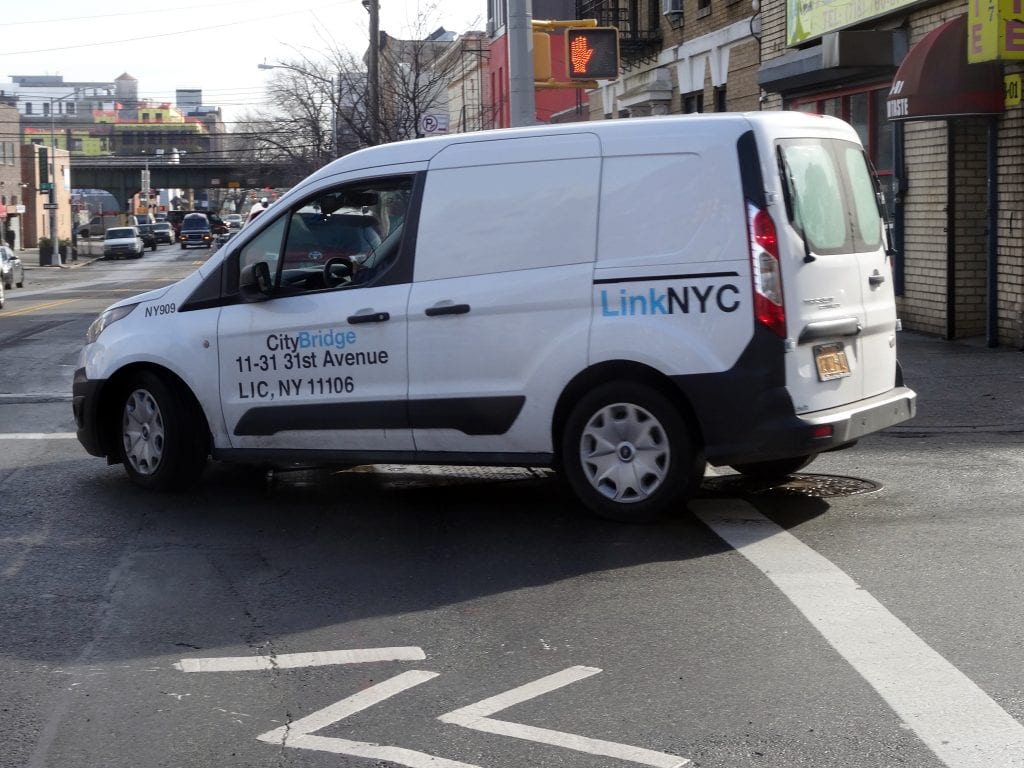
This gentleman, seen above working the inner part of the payphone enclosure, works for CityBridge, a consortium of advertising and tech companies responsible for maintenance of most of the city’s outdoor payphones. CityBridge would probably rather be known for its role in producing the advertising platters known as LinkNYC. LinkNYC monoliths currently number in the hundreds but the promise for all New Yorkers is that all 5 boroughs will be blanketed with these so-called “payphones of the future.” LinkNYC presently offers much-needed advertising and limited interactive services to select locations throughout New York.
More specific to this gentleman’s employ: his pedigree probably comes from the Titan360 portion of the CityBridge consortium. Titan360 was solely a display advertising firm until it got into the payphone business in 2010, picking up a portion of Verizon’s assets when that telco giant began its divestment from the payphone and calling card business. Other of Verizon’s payphone assets ended up with the now defunct Van Wagner, the still-thriving Pacific Telemanagement Services, and others.
The CityBridge payphone repairman is seen here photographing his work, ironically enough using his payphone-killing smartphone.

The innards of this payphone enclosure look OK. The palimpsest of some graffiti remains, but otherwise it should be suitable for all but the more germaphobic payphone customer.

CityBridge and LinkNYC sit at the bottom of a corporate org chart that will make your dial tone quiver. CityBridge is a consortium of advertising and technology companies which gets its funding from Intersection. Intersection is a division of Sidewalk Labs. Sidewalk Labs is a subsidiary of Alphabet, the parent company of Google. All roads lead to advertising, so it almost stands to reason that Google would get into this business. Advertising has essentially subsidized what is left of the payphone business in places like New York. The payphone being cleaned up by the CityBridge worker is cloaked in three advertising panels (only one visible here).
This particular Astoria/Long Island City payphone was, until December of last year, the property of Telebeam. Telebeam appears to be the last surviving independent payphone service franchised by the City of New York, though their status as a legitimate franchise seems to be up in the air. Telebeam’s existence had been hanging in the lurch pending its litigation against CityBridge and New York City challenging the legality of the monopoly franchise granted to the LinkNYC initiative. The lawsuit was dropped, but perhaps another one awaits.
A significant quantity of Telebeam’s remaining payphones, this one among them, were confiscated by CityBridge in December, after the lawsuit was dropped. A few Telebeam phones remain but they are few, and perhaps those devices maintain the Telebeam branding only as a lingering formality. We still, after all, see Verizon and even Bell Atlantic and BellSouth branding on any number of NYC payphones. Those companies exited this business long ago.
Still, as far as this uninvolved observer can tell, Telebeam just keep on keeping on.
Public records show that Telebeam was founded in 1984, the year public pay telephones were deregulated. In those days the opportunity to own a privately owned payphone business was a magnet for hundreds upon thousands of individuals and companies large and small hoping to make anywhere from beer money to millions of dollars off the loose change of telephone callers nationwide. Of the innumerable entities that took a crack at making money from privately owned payphones in the 1980s only a few survived the early pell-mell days of deregulation. Fewer still made it into the 21st century.
This story ends with the Citybridge repairman seen driving off in his van, heading to his next filthy payphone: