
From a distance of over 100 feet away I spotted something I simply could not believe. It was a newly-installed payphone, occupying a clamshell enclosure I had known to be empty for years.

The phone itself was not so new, showing the wear and tear of years out in the wilds. But in this year of 2017 to see a newly installed, free-standing payphone uncloaked by advertising was almost shocking to me. All I could do when I first spotted this payphone was laugh and ask “What?”
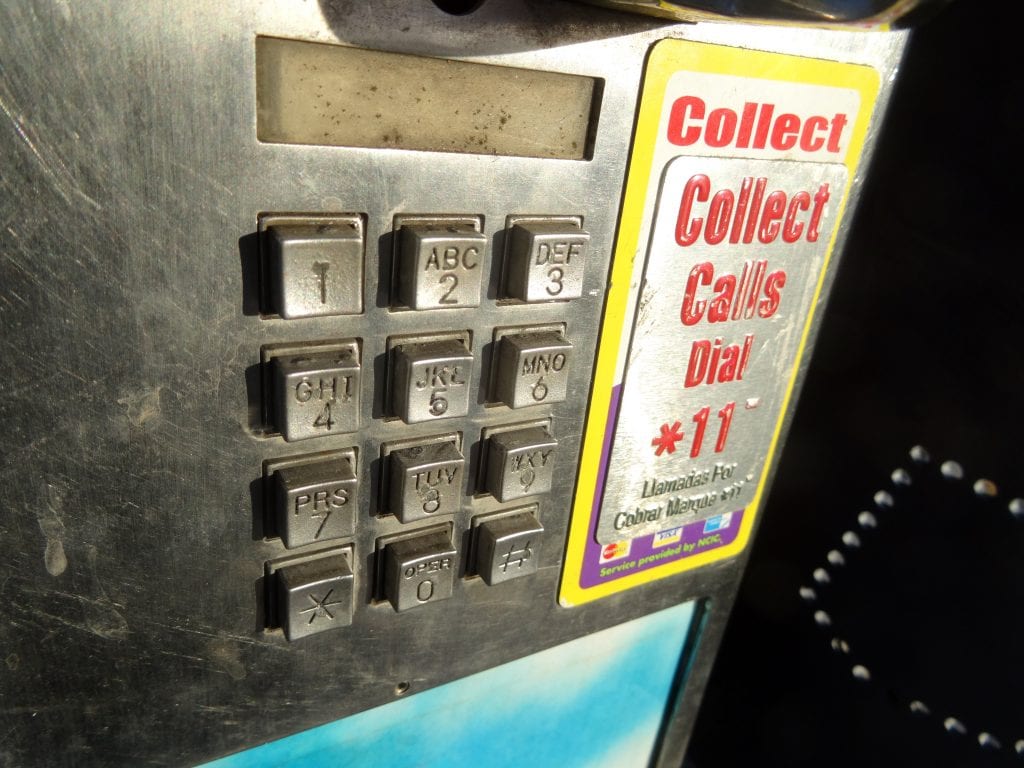
My question — WHAT? — was, of course, rhetorical, and not just because no one was around to hear me ask it. It was rhetorical because whoever was responsible for this phone probably wanted to keep quiet about it. Typically payphones are installed with permission of the City or by arrangement with a business owner. This phone was set up outside a large building that is presently unoccupied, so that little formality could be safely dispensed with.
This, dear readers, is what I call a Rogue Payphone. Installed on the parking lot of an abandoned business this phone is a solar-powered, freestanding device with (I can only assume) a wireless hookup. There is a dial tone but it must be a recorded effect, as I think it is pretty unlikely that Verizon would supply it.

Verizon exited the business of owning and maintaining payphones years ago. But they still supply the copper wire and dial tone to most of the city’s remaining payphones. There are a number of instances of payphones like this one, which run more or less off the grid using solar powered batteries and some form of wireless or VOIP connectivity. But the innards for most New York City payphones today still rely on copper wire with dial tone supplied by Verizon.
I would like to report that this rogue payphone works as well as its legitimately franchised brethren, but in my once-weekly passage of this phone I found it only worked 2 times in a period of about 2-1/2 months. Then again comparisons between the working order of rogue payphones versus “legitimate” ones is kind of a bust, since the legitimately franchised CityBridge phones frequently do not work either.
Happy to support whoever owns this device I stuffed quarters into it anyway, dial tone or not, until I got tired of doing that, and until I no longer had reason to pass this payphone by. I never saw anyone else using it, but then I only encountered this phone for a couple of minutes at a pass.
Besides being unauthorized and possibly illegal the phone has another rare quality: it allows incoming calls. But don’t bother calling unless you are sure someone will be near at hand. The ringer ie barely audible, and this phone is actually set up to accept incoming calls so as to maximize its revenue potential. The phone will ring and you can pick it up, but to talk to the person who called you have to deposit 25¢ in coins before the call is connected.
That gambit seems to be more common in other parts of the country but in New York today it is rare to find payphones of any stripe that allow incoming calls at all. A notable exception to that rule would be places like older restaurants and bars, where payphones double as the house phone. I know of two such places right in my neighborhood, where incoming calls are allowed but callers are most likely just trying to reach the bartender.
There are also a number of phones I know of that ring once, making it seem like they allow incoming calls. But if you answer that phone on the first ring you hear the device’s internal modem or some other interference which makes conversation impossible.
This phone may be unauthorized but it is probably not strictly illegal, at least not according to city bylaws. For it to be illegal it would have to have been placed on a city sidewalk, where payphones today are owned by a monopoly franchise. In the past there were numerous independent payphone service providers whose payphones required franchise agreements with the city’s DoITT (Department of Information Technology and Telecommunications). Today only one company (CityBridge LLC) is authorized to operate payphones on city property.
This particular phone happens not to be on city property, though only by inches. Its presence on the far end of an abandoned business’s parking lot probably means it will remain in place, unmolested, until a new company moves in to this location, and maybe even after that. It would be up to whoever occupies this space next to decide if getting rid of this payphone would be in their interests.
When I first spotted this phone it had Rogue written all over it. There was no information placard of any sort, as is required by FCC rules. Instead there was this teal smear, which evoked a partly cloudy sky:

That placard, which should contain contact information for the owner of the phone as well as instructions for stuff like making collect and operator-assisted calls, would probably have contained some calling instructions. But as far as contact information I would have expected it to contain innocuous boilerplate material of no real substance. This hunch of mine was confirmed weeks after the phone was erected. This seemingly legitimate-looking signage appeared in place of the previous teal smear:
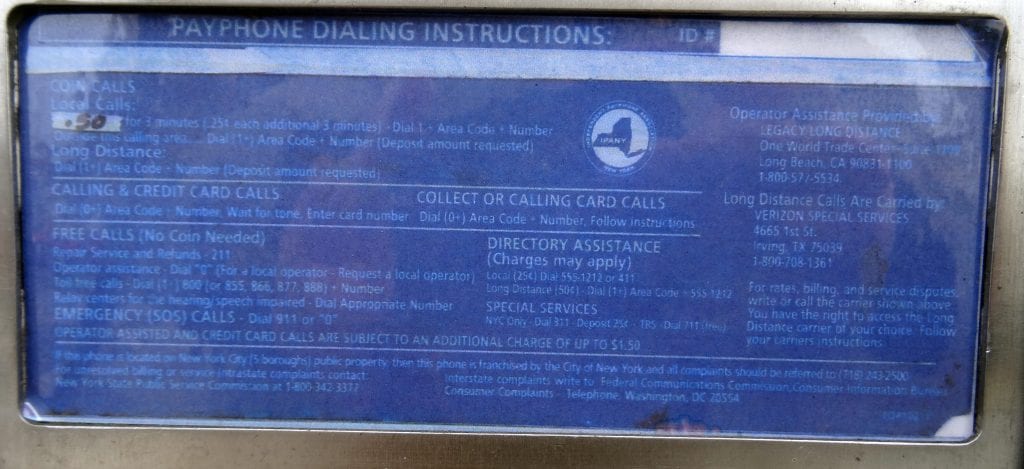
The placard bears the logo for the Independent Payphone Association of New York (IPANY), an organization which, lacking any formal announcement, has basically ceased to exist.

The association’s former domain name (IPANY.com) was, curiously enough, briefly owned by Facebook. Today IPANY.com is in the hands of a domain name squatter.
The placard contains street addresses and telephone numbers for entities including operator services
- Legacy Long Distance
One World Trade Center Suite 1100
Long Beach, CA 90831-1100
1-800-577-5534 - Verizon Special Services (for long distance calls and inquiries)
4665 1st Street
Irving, TX 75039
1-800-708-1361 - New York State Public Service Commission
1-800-342-3377 - 718-243-2500
This phone number with an unidentified owner is to be called if the phone is located in the 5 boroughs of New York City and you wish to file a complaint about it. That number appears to have passed through a number of hands over the years but today it is disconnected.
This placard and its seeming patina of legitimacy was also accompanied by the “Collect Calls Dial *11” notice similar to those found on most payphones in New York. This makes the rogue payphone look a bit more legitimate to its customer base that would be tuned in to such things.
The signage, however, has no clue as to whose phone this is, and I doubt if calling any of the numbers shown on this placard would lead to that information.
The top right portion of the signage is supposed to show a New York City Public Pay Telephone (PPT) ID, but nothing is seen there. And that is fine with me. The phone is situated in a pretty plum spot in terms of foot traffic and general visibility. Good luck to it!
Probably a Protel 8000 board in a Western Electric style housing. You mount a solar panel and put a battery in the pedestal base. A special GSM wireless adapter is connected to the phone, which can generate its own dial tone. Lots of payphones like this are installed to act as advertising kiosks but you never see it done in an L31 housing like this.
I see them here or there but it’s been a while.
This one, across from a jail, came and went within a couple of months back in 2011-2012. It appeared to be tethered to a landline, as far as I could tell:
http://www.payphone-project.com/photos/picture.php/DSC08507/category/285-mystery_payphone_van_dam_diner_718_472_2509