
 Conversations with a couple of new friends in my life last week led me to revisit my long-ago involvement with a telephone art project I worked on in the 1990s, and to dig up some old paperwork associated with it.
The Apology Line, also known as the Apology Project, or simply Apology, was a telephone confessional in which an artist, known only as “Mr. Apology”, invited the public to call a telephone number and apologize for their sins. Hundreds if not thousands of posters Mr. Apology printed and posted up throughout New York looked like the image to the right.
Later iterations of the Apology posters looked like this. I still have a stack of about 50 of these.

CRIMINALS
You have wronged people. It is to people you must apologize.
VICTIMS
Anonymous Confrontation of Wrongdoer and Wronged may lead to Reconciliation. Predator today, Prey tomorrow.
In the early days Mr. Apology placed his posters in the subways and on phone booths in areas like Times Square, the Port Authority Bus Terminal, etc. He targeted the seedy parts of town, which were not hard to find in the early 1980s.
Established on October 20, 1980, Apology was the work of Allan Bridge, an already accomplished artist who turned his skills from painting and illustration to build what evolved into a telephonic community of strangers, or as he put it, “An anonymous communion of wrongdoers and the wronged.”
But that “communion” did not characterize the early years of Apology. In its first years Apology had no feedback setup. When someone called the line they heard a recorded message instructing them to leave a statement. That was that. Recorded materials were used in museum exhibits and street art installations.
I learned of Apology through an article in the January 30, 1991, issue of the New York Press. Allan once told me that of all the press coverage Apology received, from big-circulation outlets like the Washington Post, the Village Voice, or Discover magazine, no article about Apology brought in more callers than that New York Press piece from 1991.
It wasn’t just that it brought in a lot of callers. That New York Press story brought in long-term contributors who kept Apology thriving for years to come. Mainstream media coverage tended to attract one-time curiosity seekers, though it’s fair to add that long-distance calling rates in the 1980s and 1990s would have created a barrier to callers from outside the five boroughs.
For whatever media mentions the project received Apology made no money, save for donations from callers and licensing royalties from the HBO production of Apology, starring Lesley Anne Warren. In a radio interview (CBC, I think?) Allan estimated that he spent about $100 a month on Apology, but that put no monetary value on the enormous amount of time needed to keep Apology running.
Ever attempting to find ways to make the project financially sustainable he announced on the Apology Line his plan to turn it into a pay-per-minute 900 or 976 number. The callers almost universally objected, and the idea fizzled, leaving Allan stuck with the problem of turning his labor of love into a livelihood. To me the real fear was that Allan might just pull the plug on Apology altogether.
He had pursued other possibilities, including a proposed collaboration with Ben Katchor, the comic artist who created Julius Knipl, Real Estate Photographer. I think Allan also proposed doing a radio show for the likes of WFMU or some other regional alternative radio station. He probably got as far as I have — nowhere — in trying to connect with WFMU’s station managers.
With Allan threatening to close Apology I felt inspired to take a chance and step forward from the shadows of the anonymous “Apologistas”, a term Allan once jokingly used in reference to the callers. To Apology’s Greeley Square PO Box I sent a long, probably sycophantic letter, in which I volunteered to do anything I could to bring Apology to a wider audience, and to broaden its profile into something more than just a call-in line.
I don’t remember everything I proposed in that letter but I probably suggested therein that we create a magazine, send press releases to major publications, and print up stickers or small scraps of paper with transcriptions of short apologies that we could scatter around town.
None of these suggestions were particularly innovative, and I don’t mean to give myself credit for proposing them. Publishing a ‘zine and plastering New York with stickers promoting your project were hardly new ideas in 1993.
Whatever I said in my letter worked. Mr. Apology, as I still knew him, invited me into the fold, adding that I was the first Apology caller he had ever met in person. I never knew what to make of that.
I lived way uptown at the time, so for us to work together we arranged to send stuff electronically. E-mail was not new to me in 1993 but using it from home presented a logistical challenge: I had no computer there, only at work.
So Allan gifted me an IBM XT machine he had moldering away in a closet. This is that machine, pimped up with bleeding edge Procomm Plus dialup software and the Framework Office Suite I used not just to transcribe Apology tapes but to write horrible poetry and draft messages I would later post to Usenet. Not seen in this photo is the cassette-tape transcription machine Allan lent me, which I later returned. I may never have made a dime from my involvement with Apology, but it’s no exaggeration to say this computer changed my life.

The magazine I proposed came to fruition, with its first issue published in 1993 and the last in 1996. The last was a commemorative issue published a few months after Allan’s death. During my involvement Allan paid for all publishing costs and made all arrangements with the printers. I transcribed almost all the apologies for the first 3 issues. Allan did the layout, wrote editorials and introductory comments for some content, and filled space in the layout with some of his illustrations. The last 2 pages of each issue contained classified advertisements, including an entertaining “Personals” section where anonymous Apologistas attempted to connect with other callers.

This is one sheet of stickers I printed with short apology transcripts. Upon request Allan mailed sheets of these stickers to callers with the expectation that they would place them wherever they could. I printed all of these at the office where I worked at the time.
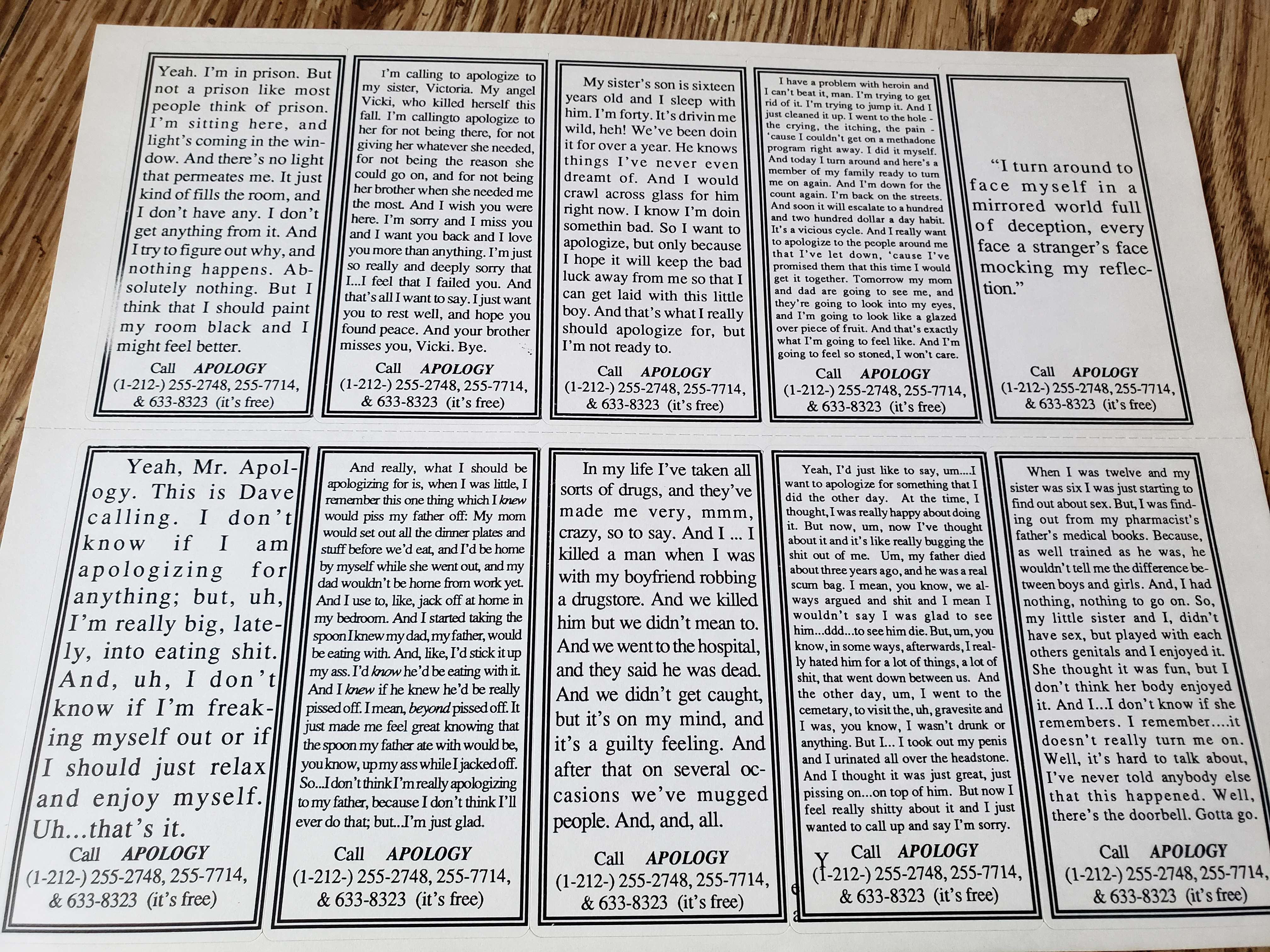 Apology Stickers from 1993
I remember Allan and I walking up 5th Avenue, sticking little tales of torment on windows and doors of places like Tiffany’s, the Trump Tower, and the Bulgari store. Someone looking to buy an $800 pair of pants might first confront a two-paragraph statement from a 40-year-old pedophile, or from someone apologizing for urinating on their father’s grave. Clicking the image above provides clearer legibility, but be warned: some of this content might hurt.
On our smallest scale I printed and chopped up thousands of these little scraps of paper, with which I littered subway cars or stuffed into payphone coin return slots. Allan commented a number of times on how the stickers and things like these scraps of paper genuinely succeeded in attracting new callers. Such means of promoting Apology might not have been innovative but I believe the actual execution of placing this type of content on public property worked in a way unique among similar forms of promotion.

I also wrote and delivered press releases to publications like New Yorker magazine, which went on to publish an 8 page story about Apology, by Alec Wilkinson.
In Short…
I could write an ocean of text about my involvement with Apology. Indeed I have, but most of it not in public. I’ll let it go for now, even at the possible expense of leaving the tone of this essay a little self-centered. Suffice to say that while my attitudes about Apology vacillated wildly over the years I will always have love in my heart for Allan Bridge, and for the callers at Apology who haunted the telephone lines for so many years.
The very name of this website, founded in 1995, is a direct and intentional shoutout to the Apology Project.
Notes: Calling WBOK?
Was Apology really the first telephone confessional? While writing this essay I happened to find that a radio personality named Donny Brooks, at WBOK in New Orleans, hosted a program called “Apology Line”, where listeners called in to talk about bad things they had done. That was 1976, four years before Allan Bridge’s Apology Line. I inquired of WBOK if any recordings survive from that program. No recordings exist, at least not at WBOK.


Another “Apology Line”, apparently from 1978, is advertised in this 30-second commercial for the number 976-8888, which charged a mere $3 for the first minute, and $1/minute thereafter. Who knew that Allan’s goal of charging callers for access to APOLOGY had precedent!
WCHB Detroit Aired an “Apology Line”
WCHB Radio in Detroit had an “Apology Line” show, hosted by either/or Jerry Hall and/or Paul Childs, during the 1980s. Whoever hosted the show took calls from listeners who talked about bad things they did, and interspersed the calls with music. I would not know if this radio show was a copycat or otherwise inspired by Allan’s project, which started in 1980. WCHB’s “Apology Line” started in November, 1983. Here is a writeup of WCHB’s “Apology Line” from June, 1984, which references Jerry “J.T.” Hall as the host, while other sources point to Paul Childs as the host of WCHB’s “Apology Line”.

I still possess bags of cassettes filled with Apology recordings. Allan gave me most of them — they bear his handwriting — but I made some of the tapes from my home answering machine. As part of my project to digitize all my cassettes and LPs I now possess hours of Apology calls in FLAC format. I play some of them back once in a while, usually for visitors. The Pupfuck “invasion” gets played more than most… If you know, you know. I also maintain a particular fondness for a call from a dude describing people who called Apology as “bubbleheads”.
During my Summer of Softee I included a couple of recordings from Apology, blasting them through LinkNYC’s loudspeakerphone. Hearing Apology blasting up and down Third Avenue felt strange enough that I never did it again. Thinking about it now, though, I imagine Allan doing something similar if he had the chance.
You can occasionally find copies of Apology magazine on eBay, but most of what turns up are copies of another magazine with the same title published in recent years. I have never found the Apology Line-related Apology magazine on Worldcat or in any library.
A full-length film called Apology, starring Lesley Anne Warren and Peter Weller, formerly pretty difficult to find on VHS, is now up for grabs on YouTube. I have not watched the film in years but I seem to remember it revolved around the infamous “BERNIE. TELEPHONE CALL.” incident.
A suspense novel called “Mr. Apology“, by Campbell Black, was published by Ballantine in 1984. All I know of this book is how Allan shook his head in dismay at the mere mention of it.
You can find the 8-page article in the New Yorker I mentioned earlier in Alec Wilkinson’s “Mr. Apology and Other Essays“.