
My recent paean to the woman who offered me use of her cellphone when she spotted me getting ready to use a payphone led to a bit of a ramble on how most of New York’s public telephones function off the grid. Solar panels atop New York’s payphone enclosures go unnoticed by all but the tallest among us, powering not just lighting for the advertising panels but also the cellular phone connection that has replaced traditional copper landlines. My previous posting may have overestimated the percentage of payphones that function off the power grid, but the quantity is impressive enough to make one question what the “payphone of the future” might have looked like if more creative thinking went toward retrofitting extant enclosures instead of destroying them.
It reminds me of the late Naicomm iSpectrum Internet Payphone, an early-2000s product I read about but never encountered in the wild. I know, it looks like a Fischer-Price toy. But if the ingenuity of efficiencies this product exhibits went into “reinventing” New York’s payphones then the payphone of the future could have evolved less intrusively, and with less waste.
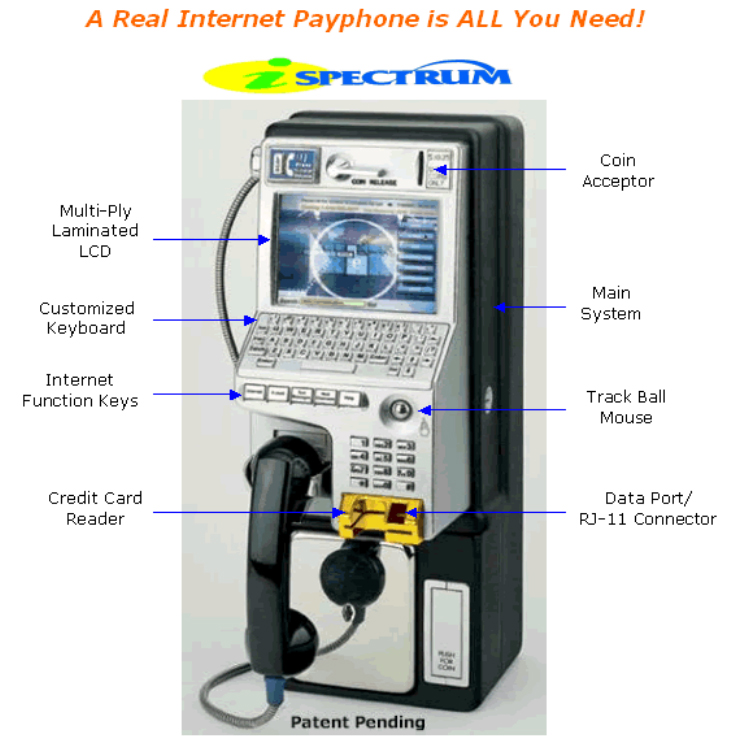
Instead of simply trashing New York’s time-proven solar-powered payphone enclosures and all the payphone hardware within the phones could have been retrofitted in the spirit of something like the iSpectrum. Static advertising panels on the sides of the old payphone enclosures could have been replaced with digital screens rivaling those of LinkNYC in size.
This happened when a handful of Times Square payphone enclosures had their static ad panels replaced with LED screens some years ago. It would be interesting to step back in time and dissect why, exactly, that initiative fizzled.
That approach of retrofitting existing hardware, combined with another failed initiative to install WiFi beacons atop existing payphone enclosures, might have made for a Smart City initiative that actually lived up to the name.
Designers of the iSpectrum appear to have aspired to rival the AT&T Public Phone 2000, probably the most successful “payphone of the future” ever deployed. The iSpectrum likely appeared in airports and convention centers, similar to AT&T’s devices.
It’s not so much the iSpectrum product itself that impresses me, certainly not by today’s standards. What I appreciate is the sanity and ingenuity of retaining elements of the old payphone hardware, and how doing so could have saved a lot of money and resource. Realistic use of something like the iSpectrum on New York City would require paring down its jumble of features. The high-maintenance physical QWERTY keyboard could have given way to a larger tablet screen and an on-screen keyboard, as we now see on LinkNYC. The Internet function keys and trackball seem like needless flourishes.
But the iSpectrum had one feature LinkNYC kiosks so badly need: a telephone handset. This would not only improve call quality. It would restore some of the human dignity one loses by shouting into those machines and broadcasting your conversations for all to hear. A physical handset would turn LinkNYC machines into phones, instead of broadcast platforms.
Technical specs (scraped off of archive.org) for the Naicomm iSpectrum follow.
|
Main System
Credit Card Reader & Data Port
|
Liquid Crystal Display (LCD)
Track Ball Mouse
Key Board
|