
A couple of interesting recent stories about LinkNYC, from decidedly different points of view, come from Venturebeat and The Intercept. I was interviewed for The Intercept piece but none of my comments were used. I assume this is because I don’t live in fear of targeted advertising or even corporate surveillance, and that I think these so-called threats are just a part of the world we live in. If anything the interview helped me clarify my own point of view on these things, and where I differ from activist groups and others who want these machines to either disappear or come under their control.
I wish that the quantity of LinkNYC kiosks was not so ludicrous, and that it was not considered unassailable to declare that traditional payphones have no reason to exist in the face of this untested and in many ways inferior “replacement”. A quantity of those old payphones should be spared for everybody, not just the residents of West End Avenue in Manhattan. Like the West End Avenue phones this quantity of citywide payphones should be programmed for free local calls and, if possible by some kind of VOIP backup or gateway, free calls nationwide. The gateway could be as simple as a free local number one can call from any payphone which then gives dial tone to call free nationwide. The phone calling app on the kiosks should be erased just because it sucks so bad. There, I said it: Save the payphones.
What I found intriguing about the Venturebeat piece was that it originally included a photo of something called “LinkNYC Alert”, an apparently abandoned idea for a smartphone app that mistakenly made its way into the article.

At first I thought “LinkNYC Alert” looked something like the Citizen app, which sends alerts notifying you of criminal activity in your area. Instead it seems “LinkNYC Alert” would have been a smartphone app that worked something like a version of 911 but somehow routed through LinkNYC, bypassing a 911 call center and sending emergency requests directly to a local police precinct. The image of the phone shows a smaller image of a phone which would have just sent a call for help. The screen reads “Emergency alert sent to local police precinct.” The big LinkNYC advertising screen reads “If you are ever in trouble, use LinkNYC to get help.” It’s too bad the text underneath that is unreadable, as it might help clarify the details behind this Alert idea. Here is the image zoomed in a little bit.
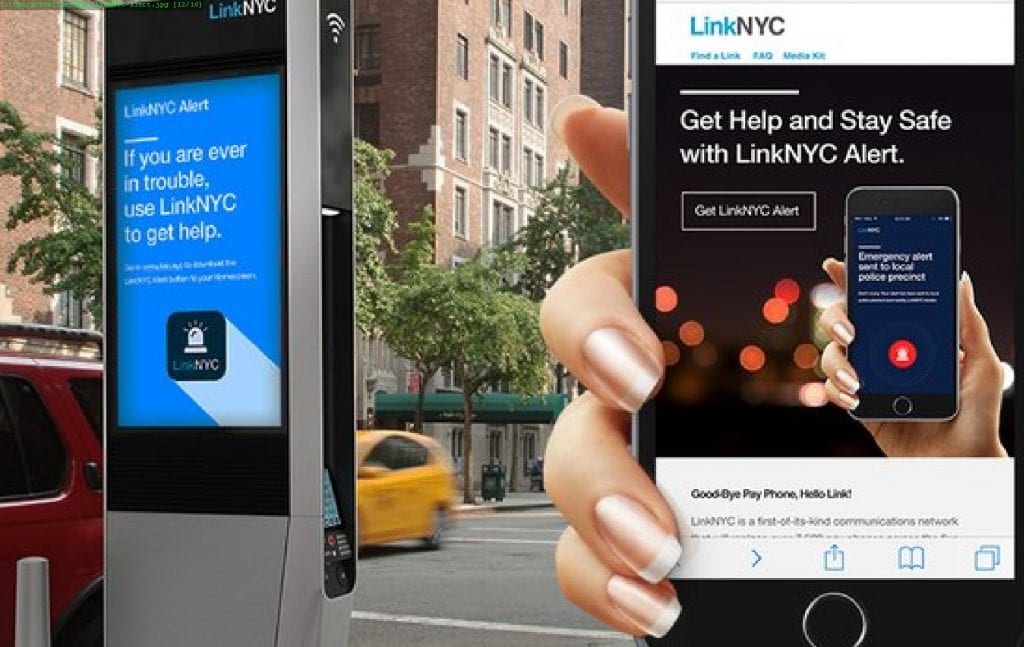
It does not seem like a particularly thought-out concept, but then that might explain why it was never implemented. But more than that it just does not seem like the kind of app that would suit LinkNYC’s general charter of selling ads and providing a bunch of free kiosk-based services. Every LinkNYC machine has a dedicated 911 button (I see kids run up to the kiosks and press that button frequently) but this implementation of making emergency calls to law enforcement looks like it would have been a standalone smartphone app. The siren logo was probably lifted from a stock clipart site (there is definitely a resemblance to this siren), but whether or not that artwork was original its presence and the relative thoroughness of the graphic design work suggests this LinkNYC Alert idea got pretty far through the corporate pipeline before being scotched.
Nothing is wrong with creative thinking, of course, so long as the bad ideas are fleshed out enough that they don’t get very far, and if they help clear the mental palette so you can get to the actual good ideas.
After I questioned the author of the story about what the heck “LinkNYC Alert” was he replaced the image in the article with a more generic stock photo from the early days of LinkNYC.
It’s not surprising to see that Intersection/CityBridge has worked through ideas like this, and it is not fair to articulate an opinion on something that was never even implemented and probably not meant for public consumption. Still, I find it a little strange that anyone at Intersection/CityBridge assumed that for emergency reporting citizens would want turn to an app provided by a for-profit commercial entity. It also makes me ask if there is any connection between this Alert concept and the code reported on by The Intercept, code which would (if deployed) have had the ability to track users’ exact latitude and longitude. I would think an emergency request app such as the hypothetical LinkNYC Alert would require location information, even with the risk that the slightest imprecision in the lat/lon coordinates sent to law enforcement could make a big fat mess of things.
Certain claims in the Venturebeat article do not quite add up, in my opinion. The headline, for starters, makes it sound like the LinkNYC network has 5,000,000 active users. That would mean that as much as half the city of New York uses these machines on a regular basis. A large portion of those 5,000,000 registrants were probably tourists, with another significant percentage comprising people who signed in once and never thought about it again.
The 500,000 monthly phone calls average out to about 9 or 10 calls per day per kiosk, although that calculation is made giving LinkNYC the extremely generous benefit of the doubt that all 1734 kiosks currently deployed actually work. Still, 9 or 10 calls per day per kiosk sounds reasonable enough. I wish CityBridge would publish usage statistics about the phone app. I would also be interested to know how the 500,000 calls made through the kiosks compares to the number of calls made through CityBridge’s traditional payphones. Some observers might not know this but the remaining quantity of payphones lining the city’s sidewalks belong to CityBridge. Not all outdoor payphones in New York belong to CityBridge, mind you, but all the ones you see on city sidewalks do. You’ll still find independently owned outdoor payphones on private property, such as parking lots, strip malls, even cemeteries.
The Venturebeat article references the fact that it was possible to vote in participatory budgeting through LinkNYC kiosks, but neglects to mention that absolutely nobody actually did vote using a kiosk. A reporter at the Brooklyn Daily Eagle, who described the process and appears to have voted in this program using a LinkNYC kiosk, was probably the one and only person in town to do that.
But the article makes another curious claim about the ability to vote in participatory budgeting via LinkNYC, saying the program “let residents as young as 11 vote via the kiosk.” It almost certainly did not happen but an 11-year old using a LinkNYC kiosk to vote in this manner would have violated the LinkNYC privacy policy, which states that no one under the age of 13 is allowed to submit the type of personally identifiable information required for the Participatory Budgeting program.
I have also never seen the “local road closures” information mentioned in this article, unless that’s in reference to something like the maps app on the tablet, which shows traffic conditions.
The article makes a somewhat grandiose claim that these kiosks are a “lifeline” for some without providing a single example of anyone who depends on LinkNYC’s free WiFi more than they do any other means.
I could go on but it’s all good. This is the kind of rah-rah writeup one expects from a Smart City-friendly publication.
I don’t have a lot to say about The Intercept piece, except that where the headline asks the question – “ARE NEW YORK’S FREE LINKNYC INTERNET KIOSKS TRACKING YOUR MOVEMENTS?” — the article answers it. The answer is no. But the headline alone has been taken by many to mean that this is, in fact, happening, and that we should all be very afraid.
Someone happened upon some questionable code on GitHub that, if deployed, appeared to be intended to track the physical location of LinkNYC users and then target them with ads. This is exactly the kind of code I would expect CityBridge to be working on, with the assumption that the ability to track individuals would be 100% opt-in for the smartphone owner and that the deployment of such code be transparent in terms of a clearly-stated privacy policy and explanation of how this targeting works. LinkNYC has talked about doing this for years, why is it surprising to find they are actually working on it? None of this code was deployed and I take it as a virtual certainty that there has never been tracking of individuals’ locations using LinkNYC’s sensors.
Then again, if the people who craft that sort of code are the same ones programming content for the LinkNYC kiosks today then I would have little faith that this “Link Mobile Observations” code would work very effectively. As I’ve groused at maybe too much length the glitchiness of these kiosks and their apparent over-reliance on automation has led to postings for “local” events that are far from the site of the kiosk, as well as bewildering bus arrival time screens that I believe are truly of use to absolutely nobody. Not only that but I think the chance of ads being effectively targeted at individuals is so extremely remote – and probably prohibitively expensive — that few advertiser would be likely to even attempt it.
I think some key points went ignored, intentionally or not I do not know. The City does have a team of inspectors who put the LinkNYC kiosks through their paces, and if they are anything like the folks who used to inspect the payphones then they must be absolutely brutal, rivalling the restaurant letter-grading inspectors known to bring business-owners to tears with their overzealous, power-starved inspections. In conversations I had years ago with acquaintances in the payphone business it sounded as if those payphone inspectors would hand out $1,000 fines without blinking an eye, and beat up the payphone owners with other types of penalties. The fines were typically either reversed or lowered significantly, but not without time-consuming appearances before city officials and other irritants. I do not know if the LinkNYC inspectors have been so zealous as that since these kiosks started appearing but with the payphone inspectors’ reputation preceding them I do not know why they would not..
An Intersection spokesperson told the Intercept that the type of data they can access about you is “technical” information. I agree. If you have concerns about website owners or ISPs being able to identify what web browser you are using, your IP address, and your operating system, then you probably should not be using the Internet at all, not even through a VPN.
Now, I know it is not paranoid to believe that a website or web server owner can figure out exactly who you are from nothing more than your IP address or other environmental variables you broadcast every time you access a web page from your home ISP or through your workplace’s Internet access. Leaving VPNs out of this discussion for now I think using LinkNYC’s WiFi to get around the Internet makes you more anonymous than if you did it from home or at work. The range of IP addresses assigned to LinkNYC (136.22.0.0/255) make it look like you are located in Kansas, although WHOIS records point to Google.
CityBridge makes what I think is an extraordinary promise that they do not and will not record or store anything about which websites you access over their WiFi using your own device. That is a claim I don’t think any commercial ISP would make, and if anything I imagine this policy might come back to haunt CityBridge if illegal activity is found to be taking place over the network.
My concern about what network activity they do monitor centers more on the tablet, where (and maybe I shouldn’t admit this) it is still possible to get to pornography and certain rogue web content if you are suitably determined and have the right instincts. I was able to get to certain non-curated parts of the open Internet a couple of weeks ago from a curbside kiosk. Nowhere in LinkNYC’s privacy policy can I tell whether this type of web browsing is being monitored or recorded. I don’t think CityBridge is paying any detailed attention to what is happening on their network, since if they were I would likely not be able to get where I’ve been going through their machines.