
An acquaintance reminded me last month of what was probably the last time the word “payphone” appeared on the front page of the New York Times. It was 17 years ago, and this website was the subject. When I found it on a newsstand I remember being impressed that the headline and my name made it just above the fold. Even my mother was impressed.
I never forgot about this article, of course. Who could forget making the front page of the New York Times? I simply had not read or even looked at it in a very long time. I forgot, considering the subject matter, how well-done and researched it was, and how the story moved.
I also remember the early stages of the process, and my skepticism that I was even dealing with the New York Times at all. An email, flagged as ** SPAM **, arrived with no subject line, and just a sentence or two saying something like “Great website! Can I call you?”
I responded with a phone number where I could be reached. A call came later in the day. Caller ID showed “111-111-1111“. I had no reason to know 111-111-1111 was the number sent out by the Times‘ headquarters. I ignored it.
We eventually connected but I remained aloof, doubtful that an entity like the Times was serious about covering a website many still regarded as a joke, or a kiddy-phreak waste of time.
But I warmed up when I was convinced the editors had done their research. In building an outline for a serious story about this they felt I had suitably distanced myself from the phone phreak scene, a world I deliberately avoided until just a few years ago.
My reasons for this avoidance are explained in this video, in which the connections among myself, Article 18 Section 2701 of the U.S. Penal Code, and the 1980s/90s world of phone phreaking is explained.
The Times allowed me to clearly explain that the site, started as an art project, evolved in unexpected ways, becoming a genuinely useful niche resource to fill gaps of knowledge where telephone companies and law enforcement were either unwilling or not nimble enough to be helpful. I committed more resource to this site after discovering how difficult it was (and still is to this day) to match payphone numbers to their locations quickly enough for the information to be useful.
You can access the story on the Times website. Here is how it appeared in print, May 13, 2004:

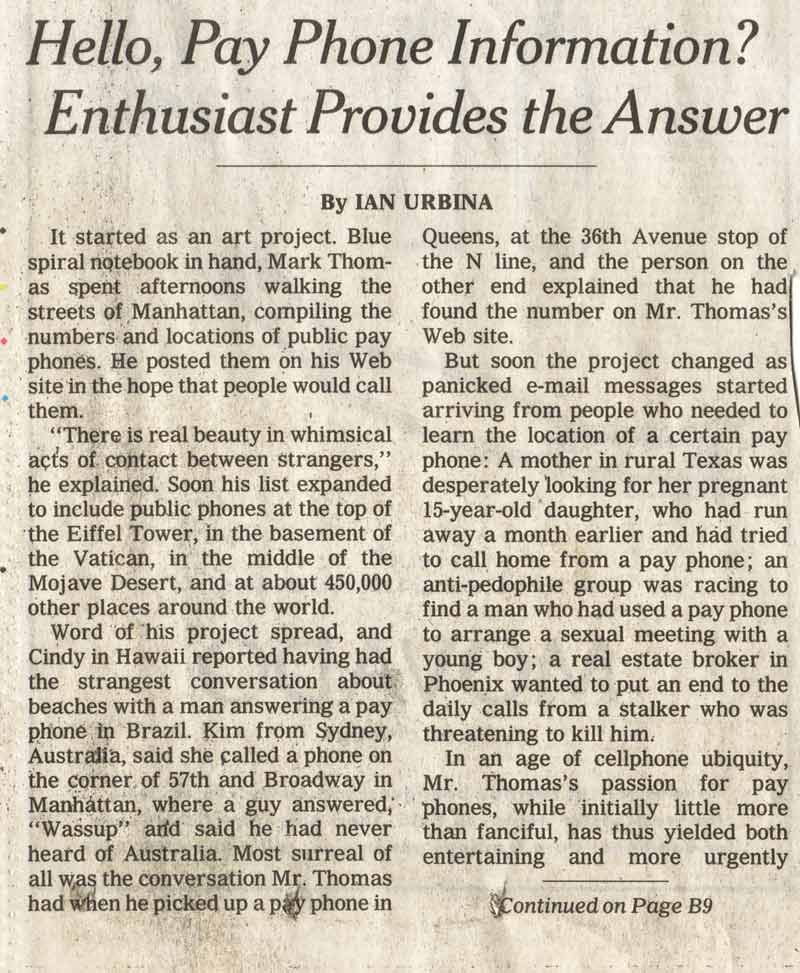
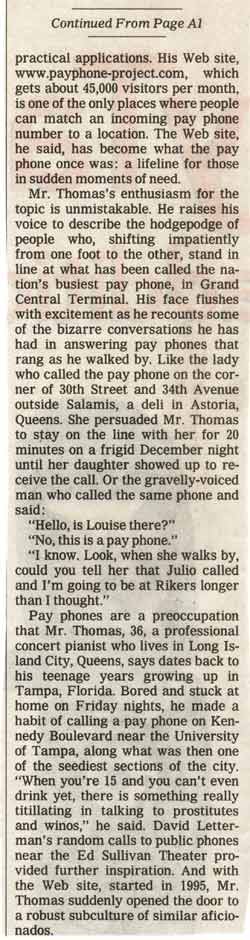 |
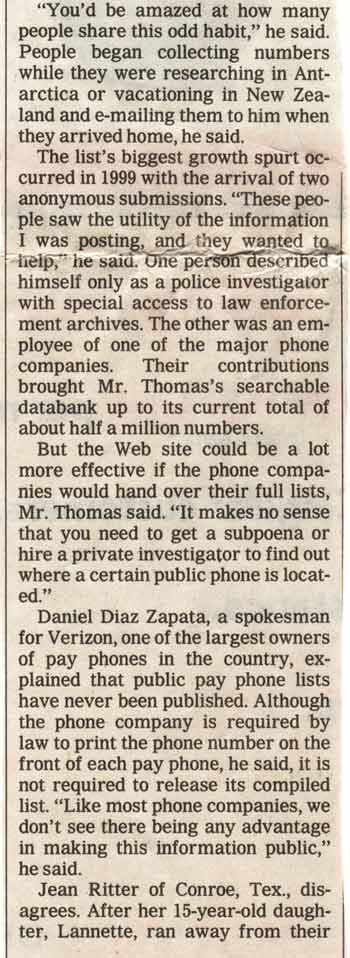 |
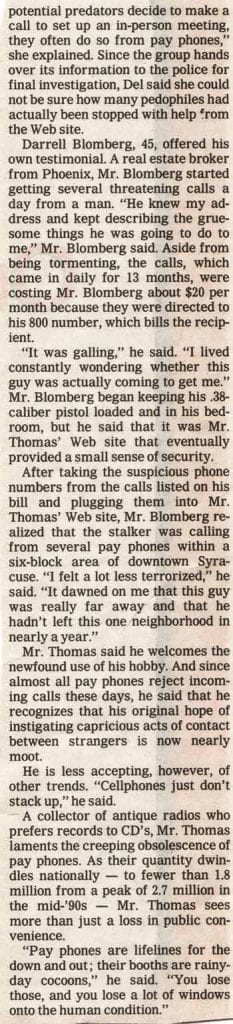
In the past the likeliest reason payphones would have made the front page of the Times would have been to report on increases in call rates from 5¢ to 10¢, or from 10¢ to 25¢. That would have been a perfectly reasonable front page story in the 1970s or 1980s, when payphones were a core piece of how American’s communicated, and thus cost of usage was an issue.
Going forward circumstances I can imagine payphones making A1 again would be if they were found to have once again been used by terrorists in planning attacks, or if some heinous crime becomes associated with any of the few remaining payphones across this land.
When the next blackout or earthquake strikes and LinkNYC kiosks are found to be useless public communication devices there may be a reckoning that calls for a renaissance of the copper-line public pay telephone, or a comparable communication device that can be expected to work throughout a lengthy power outage.
I reluctantly pinned the Times article to the Payphone Project Twitter feed, reticent to do so partly because the article is from 17 years ago, partly because I remain unwilling to fully embrace social media, but also because I just do not feel comfortable doing anything that appears to promote myself. I don’t like promoting myself. I do it awkwardly and, especially in the social media realm, with a sense of drowning in an ocean of people whose identities and/or motives rarely become clear to me.
Nevertheless, with regard to Twitter, I remember taking a wee bit of pride in crossing the threshold of 1,000 followers there. I never purchased, coaxed, or even asked for a single follower, and in that respect 1,000+ seems like a lot. I almost certainly have spammy or bot followers but from what I can tell virtually all my followers are what the social media biz would call “organic”. Yum.
I remember seeing an artist sitting in a wheelchair outside the Schwartzman branch of the New York Public Library. He had a sign saying he was homeless. I heard him say “I was front page New York Times once.”
I wanted to say “So was I, pal. So was I.”