
Having made a decade+ long project of photographing people using payphones in New York City I willingly evolve with the times. This is my first photo documenting someone using a Link. Links are the blandly named multi-purpose digital depots that could replace most of New York City’s outdoor payphones. This man (he appeared to be a traveler) was actively engaged in using the Google maps feature of a Link device at 3rd Avenue and 50th Street last week.
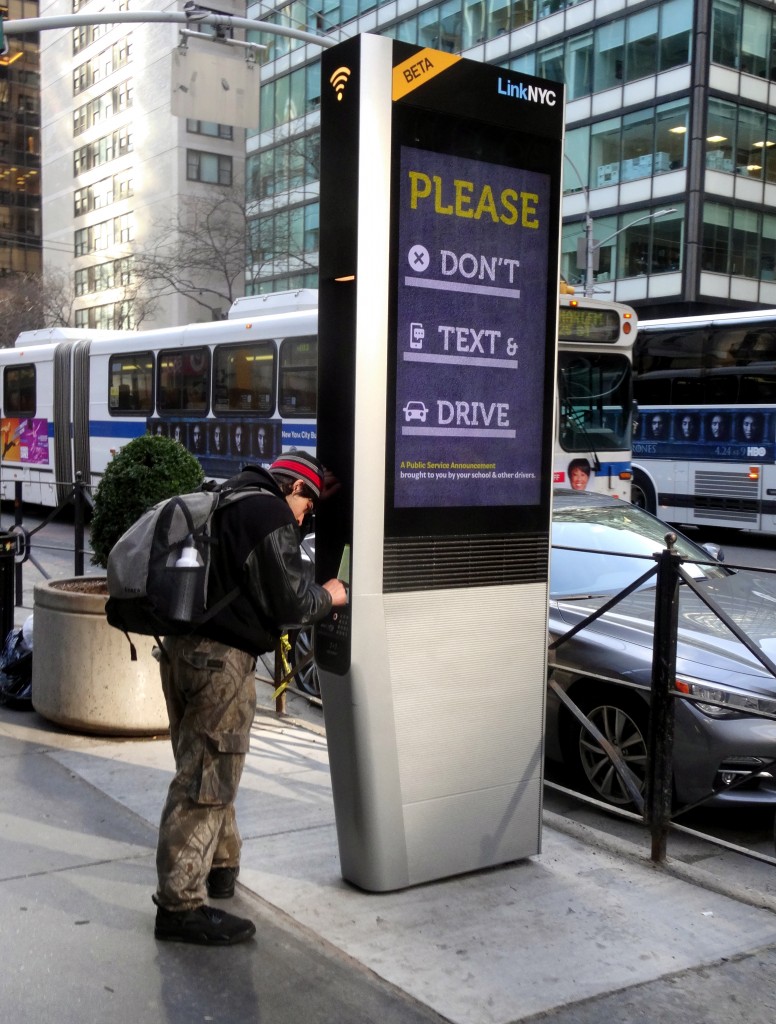
I have used CityBridge’s Link devices a number of times since a quantity of them went into active service a few weeks ago. As I mentioned in my first write-up of Links on February 29 my main interest in these devices is their ability to make phone calls. I say this begrudgingly, knowing full well that this is far from their primary reason to exist.
It turns out the “free phone calls” feature is worth about what I paid to use it.
Call quality was uniformly awful on every Link device I used. Links were not built with any kind of noise cancelling element. To the person you call your voice is heard at the same volume level as car horns blasting and other street noises. I found myself talking quite loudly, conversing walkie-talkie style, but the people I called were constantly asking me to repeat what I just said. Do you know how poor it feels to be screaming into a slab of plastic, trying to be heard?
If I gave Links’ call quality the letter-grade of a “D” instead of an “F” it is only because I was eventually able to communicate just a little bit with the people I called. But it was quite a challenge.
I also found that making calls was not as easy one might expect. I have never felt like someone who has trouble dialing a telephone number to make a phone call but these Links had me feeling like just such a person. My carefully-dialed calls frequently did not go through on the first attempt. In those cases the only signal I got that the device even worked was a sharp sound (a “logo sound” indicating the call failed?) followed by the LED screen returning to the dial pad.
It is both a feature and an annoyance that the number you dial only shows up on the screen one digit at a time. By the time you’ve dialed all the digits the numbers you entered have disappeared behind a string of asterisks. That’s obviously a security mechanism but also kind of a nuisance when the call fails to connect and you cannot tell if it’s because you misdialed.
Links’ lousy call quality strikes me as problematic and it is not simply because of my inability to conduct a normal conversation. It also could create a potential public safety hazard. If call quality is equally bad for calls made to 911 then anyone using a Link to report an emergency may find it extremely difficult to communicate details of the situation to a dispatcher.
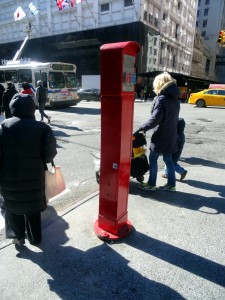
I noticed that several Links happened to be placed near red emergency call boxes, such as this one (pictured at right) across from Bloomingdale’s. This prompted me to imagine that the city could finally rid itself of at least a portion of those call boxes, which represent a technological albatross that simply will not die. The city was forced to maintain those call boxes to comply with the Americans With Disabilities Act (ADA) after a judge ruled that no viable alternative had been presented for deaf and speech-impaired individuals to report emergencies. The stubborn survival of those call boxes is really quite an involved story which I wrote about in December, 2012.
I don’t think Links will replace those call boxes, even in quantities limited to those that happen to be located in the vicinity of a Link. The ADA is some potent legislation, and I doubt that a judge would allow a private for-profit company to take over public access to something like 911.
The red call boxes are described as a money pit but however many millions of dollars the city spends to maintain them (and the jobs sustained by doing so) should be subsidized quite nicely by all that advertising revenue the Links are expected to generate. It does seem ironic, though, that this new technology might help keep an ancient one alive.
One of the traditional public telephone’s enduring values to society has been its ability to function in emergency situations. It remains to be seen if Links will live up to that reputation, and what role they might play during the next blackout or superstorm.
The free Wi-Fi – when it works – seems to deliver what one would expect. A Link at 3rd Avenue and 48th Street provided sufficient bandwidth for streaming Netflix, this after only a few moments of chunkiness in the quality of the video. A Link at 35th Street, however, provided no network connectivity even though I successfully connected a tablet to its public Wi-Fi signal.
For the time being the problem with crafting a comprehensive review of Links is that so few of them work. Many of them are clearly flagged as “coming soon” but several Links that are supposed to work do not.
A map at Link.NYC indicates that a Link at the northwest corner 42nd Street and 3rd Avenue works and is offering free Wi-Fi. This is not true. I spotted it about 10 days ago with this “Just a Sec” message. Several “secs” later (about a half hour, actually) the message was still displayed. A few days later the device was turned off — save for the advertising displays, which were going strong.
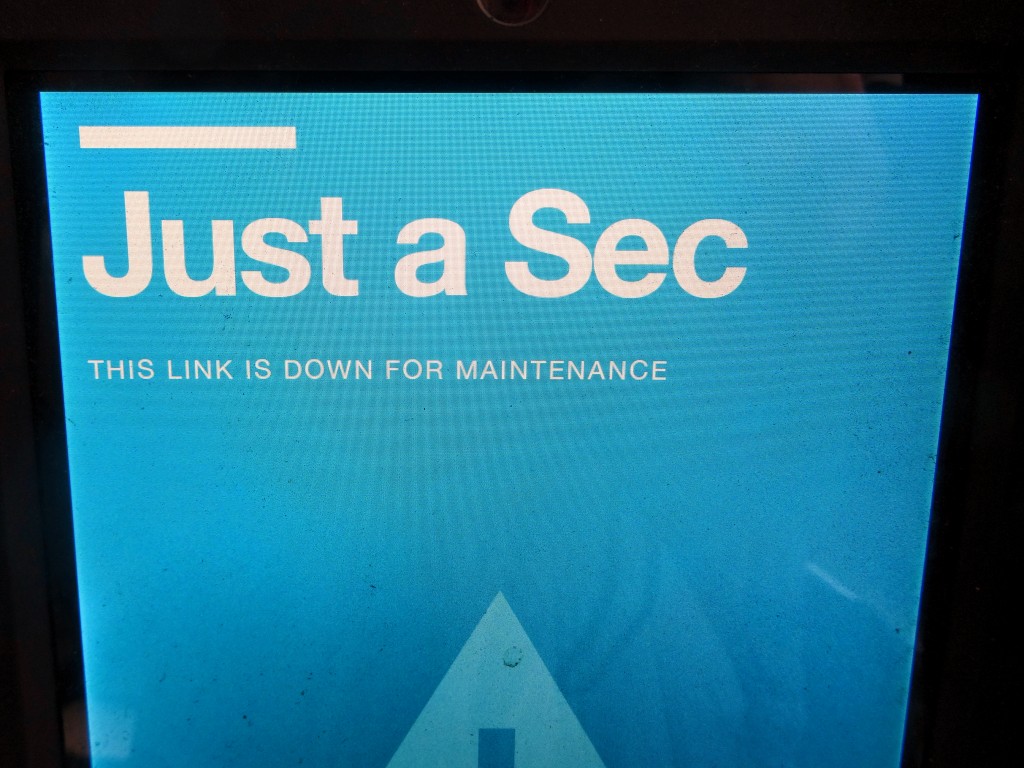
One would think the technology exists to update that map in real time, highlighting the working Links and not including ones that are down. It is not enough to know where a Link is when you could be wasting your time getting to it.
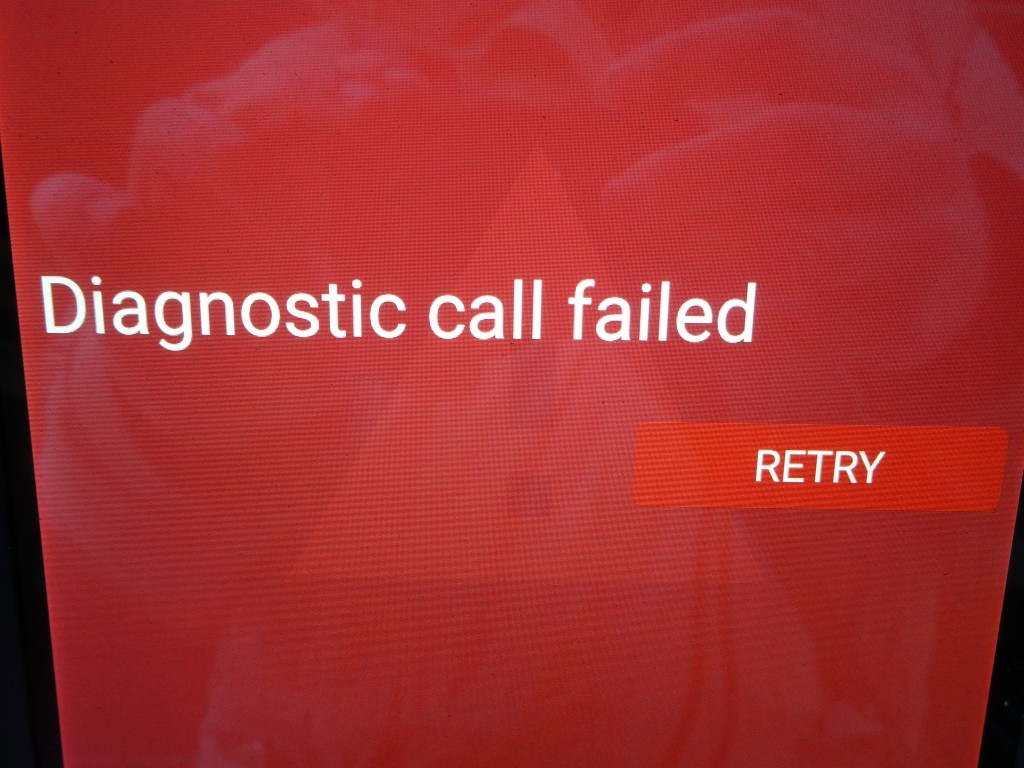
This somewhat troubling “Diagnostic call failed” message filled a surprising number of Link screens. What the heck does this mean, and what kind of trouble will I land in if I press “Retry”?
I know no one at CityBridge, and have no way of knowing if these technical problems will be emblematic of the Links project. The aggressively rapid placement of these devices must certainly be stretching the company’s resources at this early stage, with new installations and promised advertising displays taking priority over day-to-day maintenance.