
I originally posted this in June, 2012. You can tell it’s me from the reflection of the Charlie Brown t-shirt I was wearing. More interesting are the scratches on the surface of the phone. It might have nothing to do with her, and it would seem to be unintelligible, but in spirit at least it appears to be a vestige of the scratchiti artist known as PRAY.
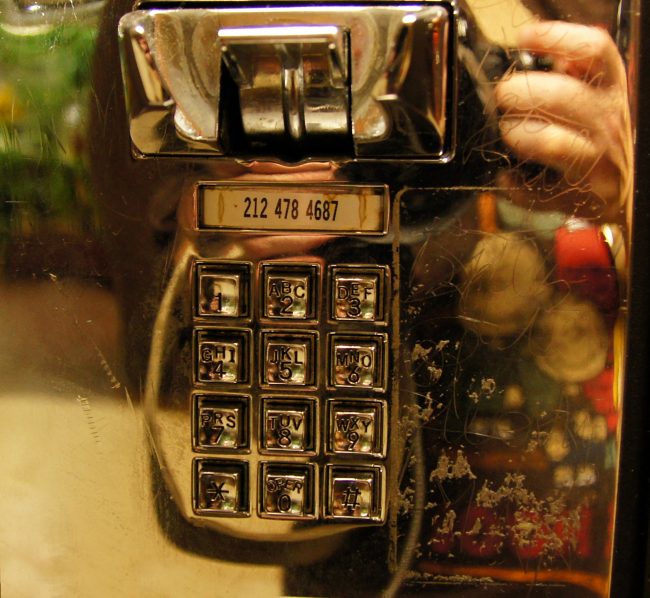
I moved to New York in 1990 and remember seeing things like “PRAY” and “LOVE GOD” scratched into payphones and other metal surfaces around town. It was a store manager at Tower Records who pointed this out to me, saying it was the work of “some old lady” who had allegedly scratched words like these into “every payphone in New York City.”
No one seems ever to have identified the woman known as PRAY but her messages, while considerably harder to find than they used to be, are still around on a small quantity of payphones and other objects. I have made an on-again/off-again point of looking for more traces of PRAY in the so-called wilds of New York. I have captured a couple of images of what I believe to be authentic PRAY scratches, some as recently as this year. But in the ocean of images I have accumulated over the years I have no idea where they are at the moment. I intend to follow up on this, if only for my own edification. It’s the sort of thing I never think to share because I don’t think anyone but I would be interested.
In 1990 I was already inclined to think of payphones as communication tools for the seedy elements of society. But in retrospect I think the PRAY anecdote was one of the things that led me to also see payphones as focal points of obsession.
Another contributing factor to both these lines of thinking was my work with a telephone art piece called the Apology Project, also known as the Apology Line, or simply Apology. As its name suggests Apology was a telephone confessional, a set of phone numbers answered by ordinary Panasonic answering machines. People called Apology to anonymously describe crimes they had committed and things they had done for which they just wanted to say they were sorry. Some of the calls were pretty compelling, others quite tedious.
I helped produce “Apology Magazine”, in which I transcribed a number of the statements left by callers. It was years after my involvement with the project ended before I realized how central payphones were to Apology. Allan Bridge, the artist who originally created Apology, routinely warned callers that if they were calling to report serious crimes they should be sure to use a payphone, to avoid the call being traced. Sometimes calls would have to be cut short as the “thunking” sound of the payphone warned that the call would end if more coins were not deposited.
I just saw a PRAY on the D train on my way up to visit the 79th Street Boat Basin payphones (no more dial tone) and it brought me back!
Wow, that sounds like an old subway car… Those old green phone booths at 79th Street are among my favorites.